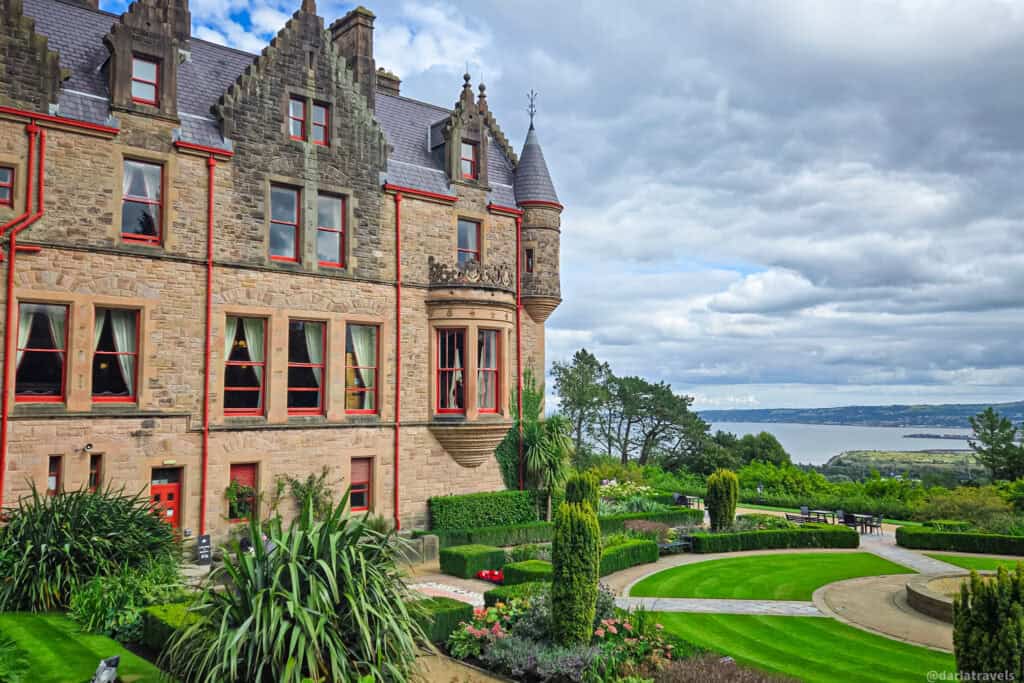
Hidden among the grounds of Belfast Castle are a series of nine artistic representations of cats, each with its own mood and personality. Spotting all nine has become a visitor favorite. The scenic castle, styled like a romantic Scottish baronial estate, draws visitors for its grand architecture, landscaped gardens, and sweeping views over Belfast. But once you arrive, the opportunity to treasure-hunt for hidden cats amid the features of the landscaped gardens is nearly irresistible.
Belfast Castle and its famous Cat Garden are within the boundaries of Cave Hill Country Park, about four miles (6.4 km) north of the city center of Belfast, Northern Ireland. Situated on the eastern slopes of the Belfast Hills, this park encompasses not only Belfast Castle, but walking trails, archaeological sites, and wildlife habitats, among other features.
Keep reading to learn more about Belfast Castle, why you should visit, why it has a Cat Garden, and all about the cat statues, mosaics, and other cat art at this charming 19th-century landmark.
** Darla Travels is reader-supported.
When you buy through our links, we may earn a commission. **
Find a great place to stay in Belfast:
- Why Are There Cats at Belfast Castle?
- A Brief History of Belfast Castle
- Finding the Belfast Castle Cat Sculptures and References
- Exploring Belfast Castle Estate Beyond the Cats
- Exploring Cave Hill Country Park
- How to Get to Belfast Castle
- Practical Visitor Information
- Where to Stay Near Belfast Castle
- The Cats of Belfast Castle: Pin It for Later!
- Final Thoughts on Belfast Castle and Its Famous Cats
Why Are There Cats at Belfast Castle?
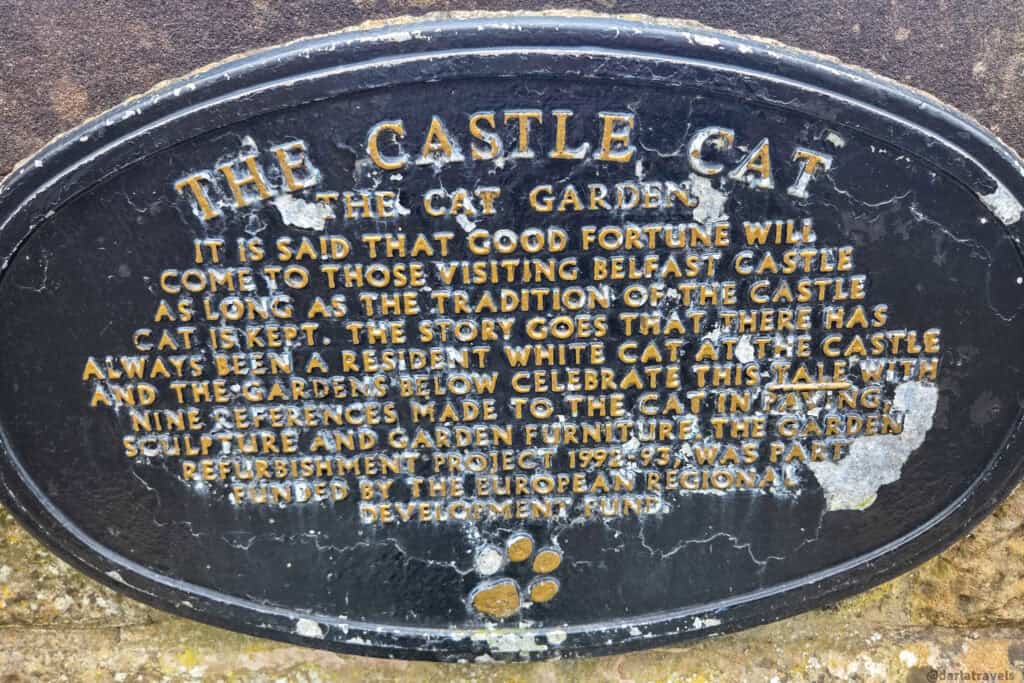
Belfast Castle’s cats trace back to a local legend that the castle and its visitors would enjoy good fortune as long as a resident cat, preferably white in color, lived on the estate. This legend is inscribed on an oval plaque at the top of the terrace, overlooking the Cat Garden. It reads:
The Castle Cat
The Cat Garden
It is said that good fortune will come to those visiting Belfast Castle as long as the tradition of the Castle Cat is kept. The story goes that there has always been a resident white cat at the castle and the gardens below celebrate this tale with nine references in paving, sculpture, and garden furniture.
While the on-site plaque, tourism materials, and tour guides repeat this legend, I was unable to find “hard” references to the white‑cat story in scholarly histories or standard encyclopedias of Belfast or Irish castles. But even if the keeping of a white cat within the castle grounds is not a proven historical custom, it makes for an enchanting story.
When Belfast City Council restored the castle grounds in the 1980s, designers leaned into this lore by creating the dedicated Cat Garden, adding nine cat motifs in stone, metal, planting, and mosaic so the “lucky” cat would always be present.
A Brief History of Belfast Castle
The original Belfast Castle stood in what is now the city center and was first built by the Normans in the late 12th century. This castle was rebuilt by Sir Arthur Chichester on the same site in 1611. The hereditary branch of the Chichester family that rose to prominence in Ireland was the Donegall family.
Fire destroyed Chichester’s castle in 1708. It was never rebuilt, and the Marquess of Donegall lived elsewhere after this tragedy.
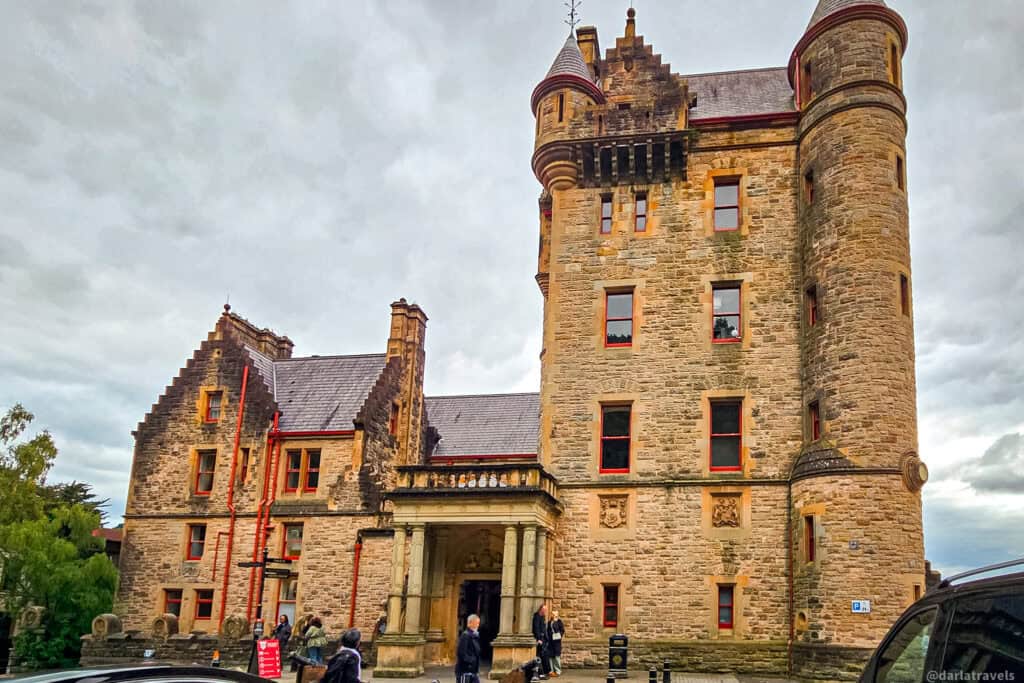
The current Belfast Castle stands on the grounds of the former deer park of the Third Marquess of Donegall, who conceived the idea for a new residence over 150 years after the fire, in 1862. The present castle, reflecting the then-popular Scottish baronial style, was finished in 1870.
(I visited another Scottish Baronial style castle in Ireland’s Glenveagh National Park-click here to read all about it.)
After the death of the third Marquess of Donegall in 1884, the castle and its estate passed to his son-in-law, Lord Ashley, the seventh Earl of Shaftesbury.
In 1934, the Shaftesbury family gifted the estate to the City of Belfast, and after the major restoration in the 1980s, the landmark castle reopened as a modern event venue. As indicated previously, this restoration included the creation of the Cat Garden and installation of the cat art pieces within it.
Finding the Belfast Castle Cat Sculptures and References
By now, you know that the nine Belfast Castle cats are clustered in the formal Cat Garden directly below the main terrace on the seaward side of the castle. The garden area is connected to the terrace by a staircase.
Once you step down into this garden, searching for the cats becomes a small scavenger hunt.
Instead of telling you where all the cat objects are, I’ll simply describe them, then leave it to you to hunt them down on your visit to keep the excitement of searching fresh. But I will give you some good clues with the photos here.
Cats in the Form of Sculptures
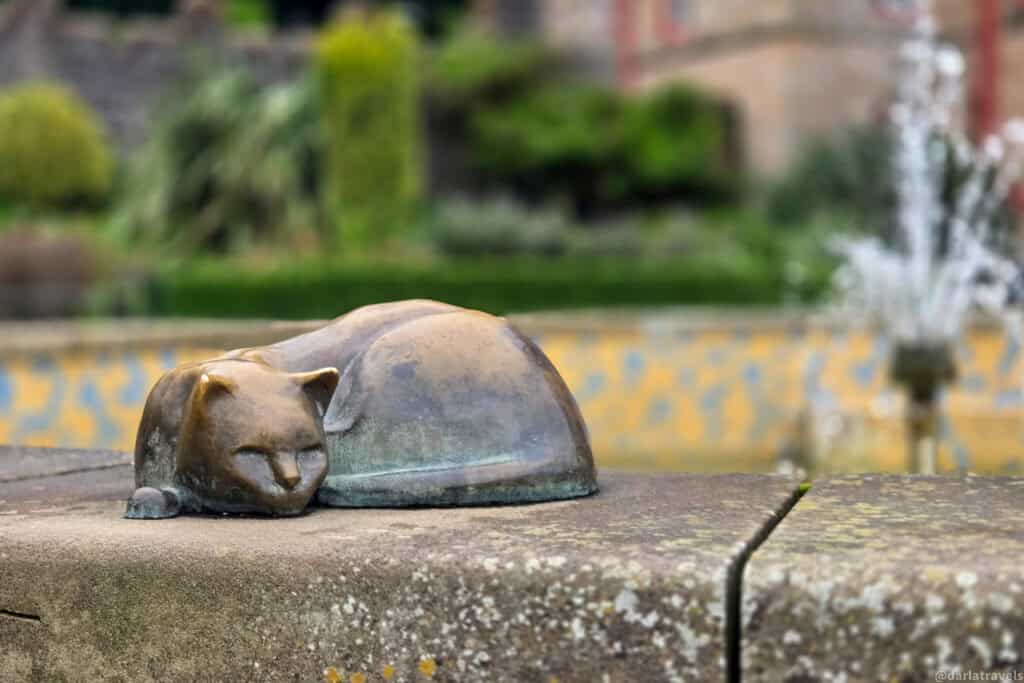
Four of the cats take the form of sculptures. Housecats sleep an average of 12 to 16 hours per day. So it’s no surprise that the sleeping cat features in the cat garden sculptures. Indeed, there are two different sleeping cat sculptures in the garden.
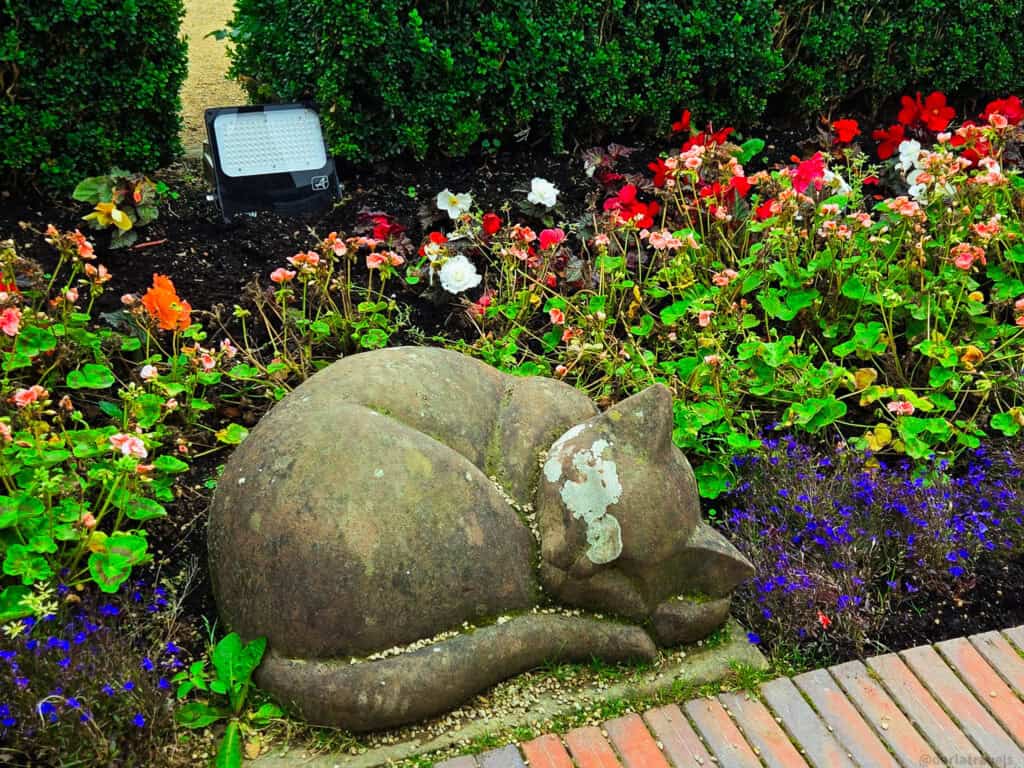
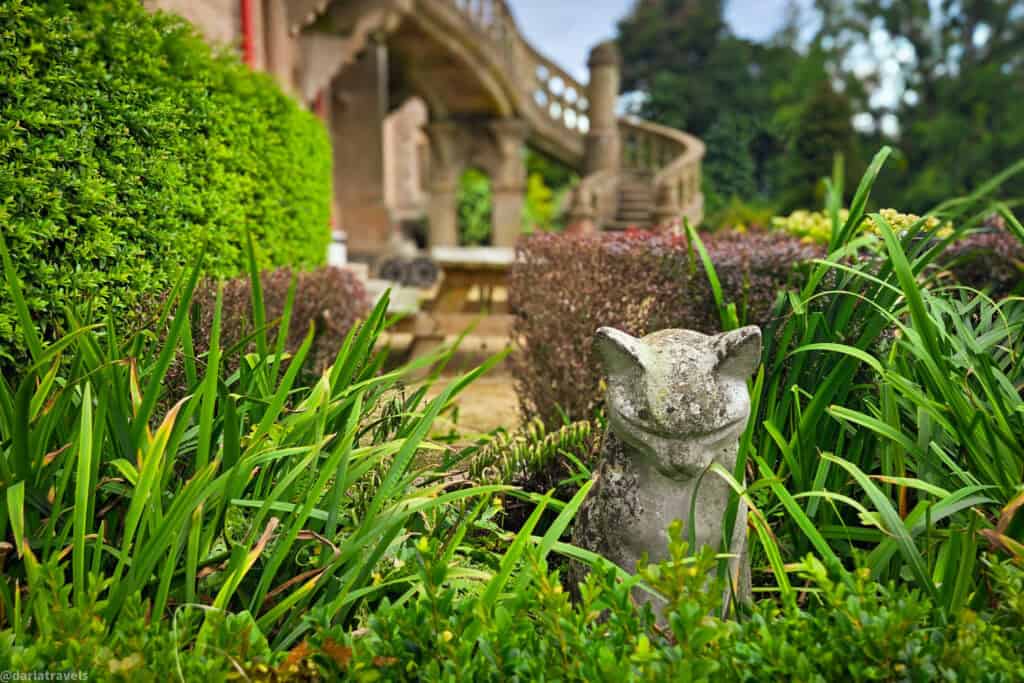
The third cat sculpture depicts a cat that appears to focus on a mouse or other prey hidden in the plantings.
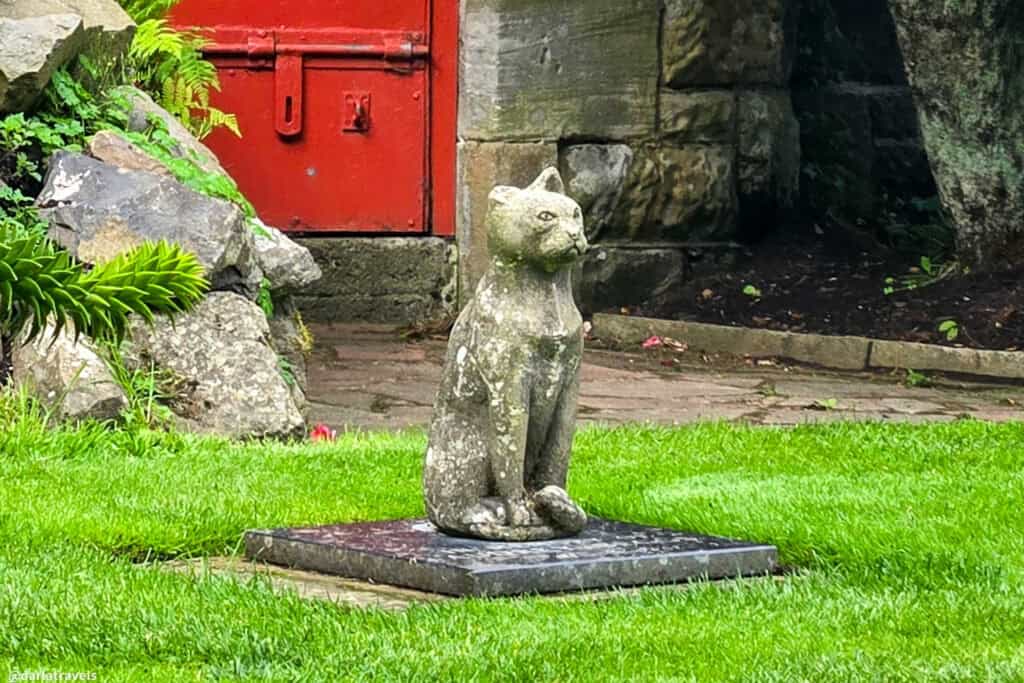
Finally, a pensive-looking upright cat sits on a stone slab memorial reading “In memory of Audrey Beggs, Cat Lover.”
The Topiary Cat
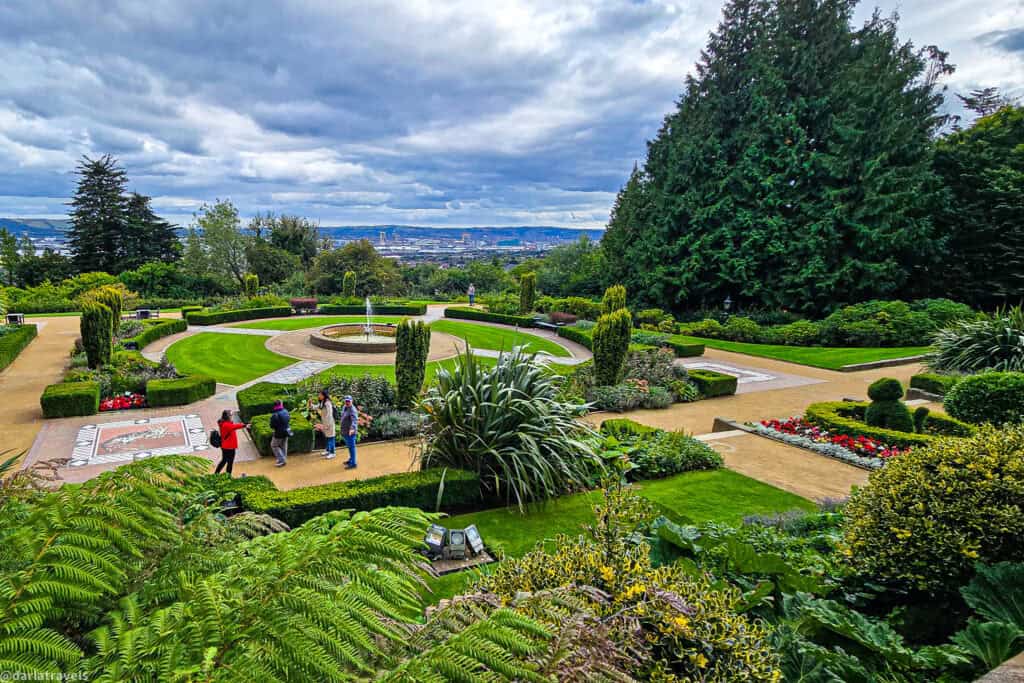
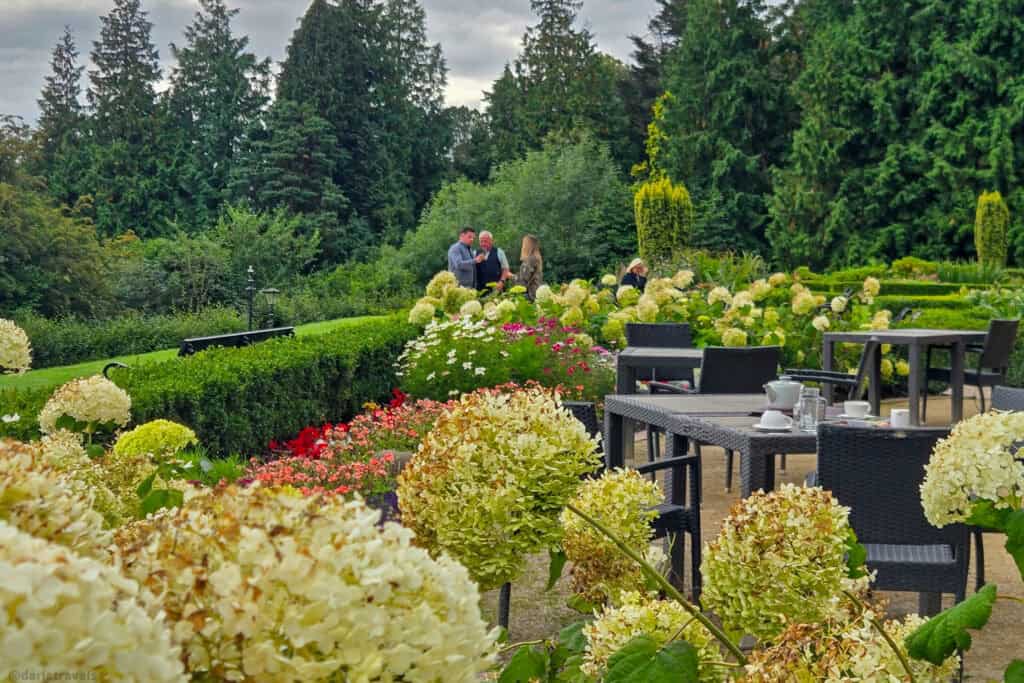
A tall bush in the garden has been pruned and trimmed into a feline topiary. I didn’t get a direct photo of this cat, but can you see the back side in this photo of the garden?
The Mosaic Cats
Two more cats are set into the pavement as tiled mosaics. One reclines, the other sits upright.
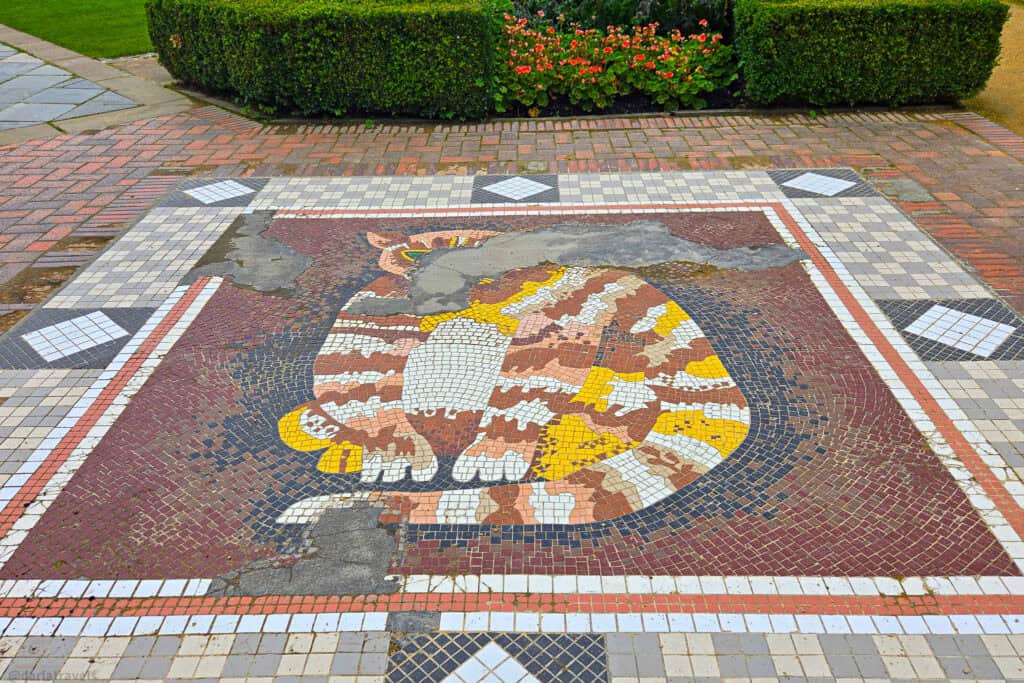
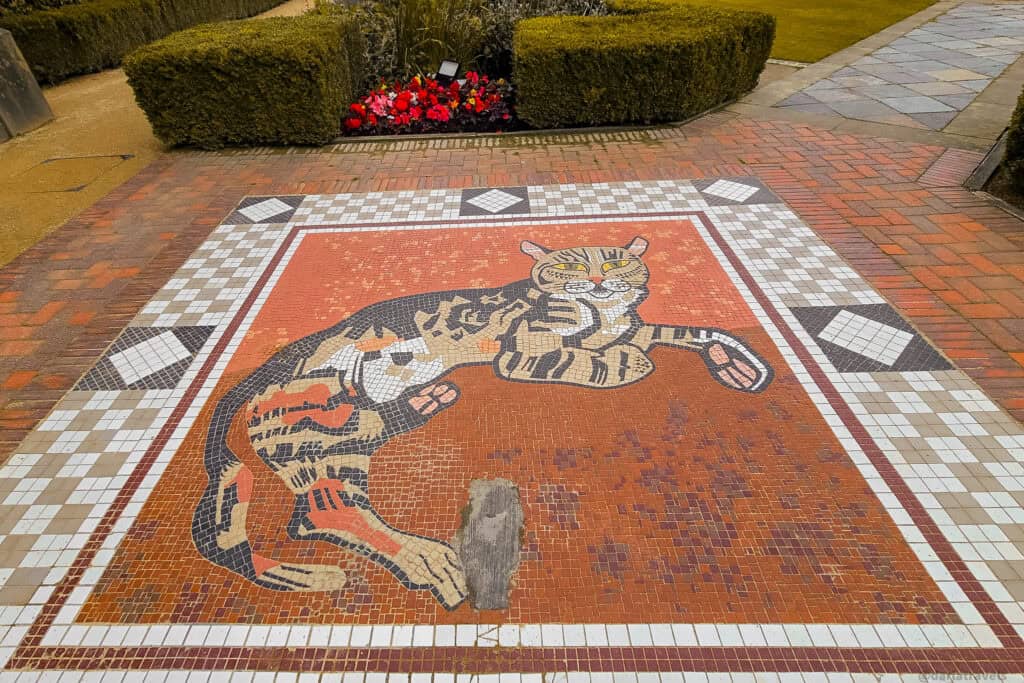
The Cat Quote
One cat reference might be easily overlooked. It’s an understated flat garden stone set into grass containing an engraved quote from T.S. Eliot.
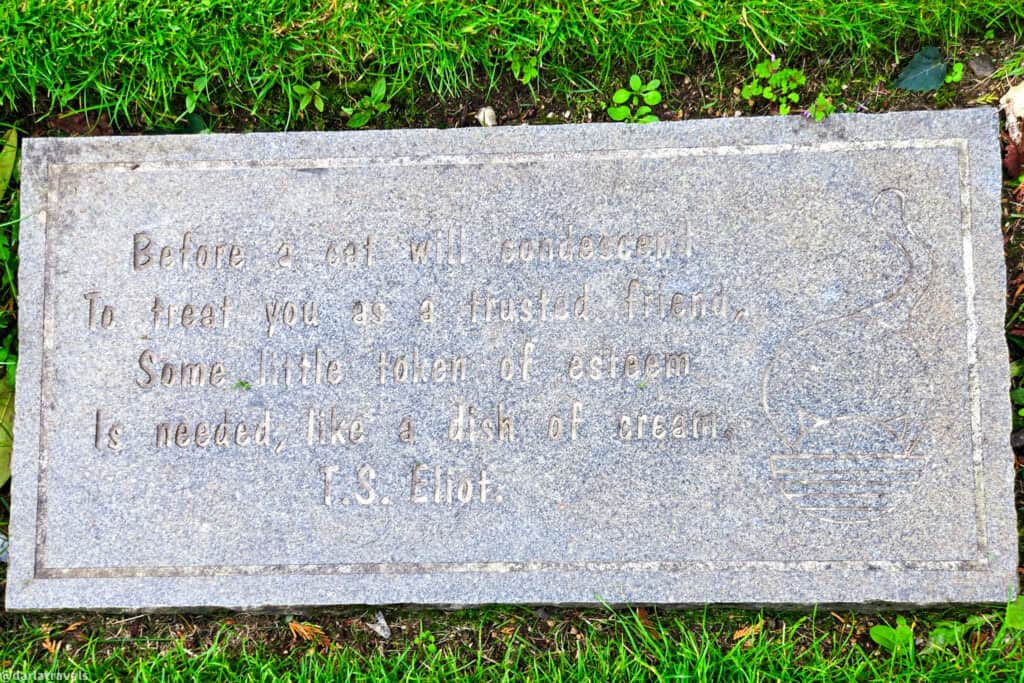
The stone is difficult to read and photograph. The words say:
Before a Cat will condescend
To treat you as a trusted friend,
Some little token of esteem
Is needed, like a dish of cream
That line comes from Eliot’s poem “The Ad‑dressing of Cats,” in his book Old Possum’s Book of Practical Cats.
The Bench Cat
The Cat Garden has several metal benches for visitors to sit on. A cat romping with a ball of yarn has been incorporated into the design of the seat of a single bench. I could tell you there is no photo of this cat to increase your inquisitiveness, but the truth is that I never found it. Leave a comment below if you’ve seen it!
Cat Number Ten?
If you’re still reading, you’ll see that the cat count is up to nine, meaning that all the garden cats should be accounted for. But there is yet another prominent cat in this garden. It’s a whimsical folk-art style cat on a tile in the wall behind the memorial cat.
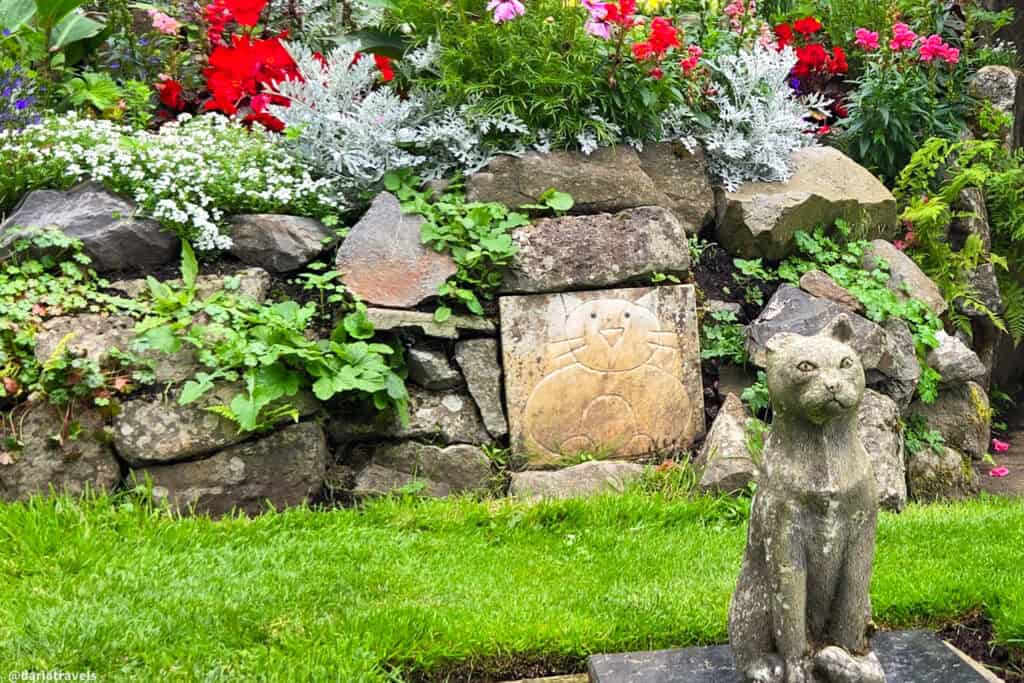
I don’t know the explanation for why there seem to be ten cats when there should be nine. I also don’t know which of the nine cats are original and which one was apparently added later.
One more cat definitely adds to the charm of the Cat Garden. In a garden built on the idea that a resident cat brings good fortune, an “extra” one feels less like an oversight and more like a bonus for anyone who looks closely enough to notice.
Exploring Belfast Castle Estate Beyond the Cats
Exploring the castle and Cat Garden will take approximately 1-3 hours.
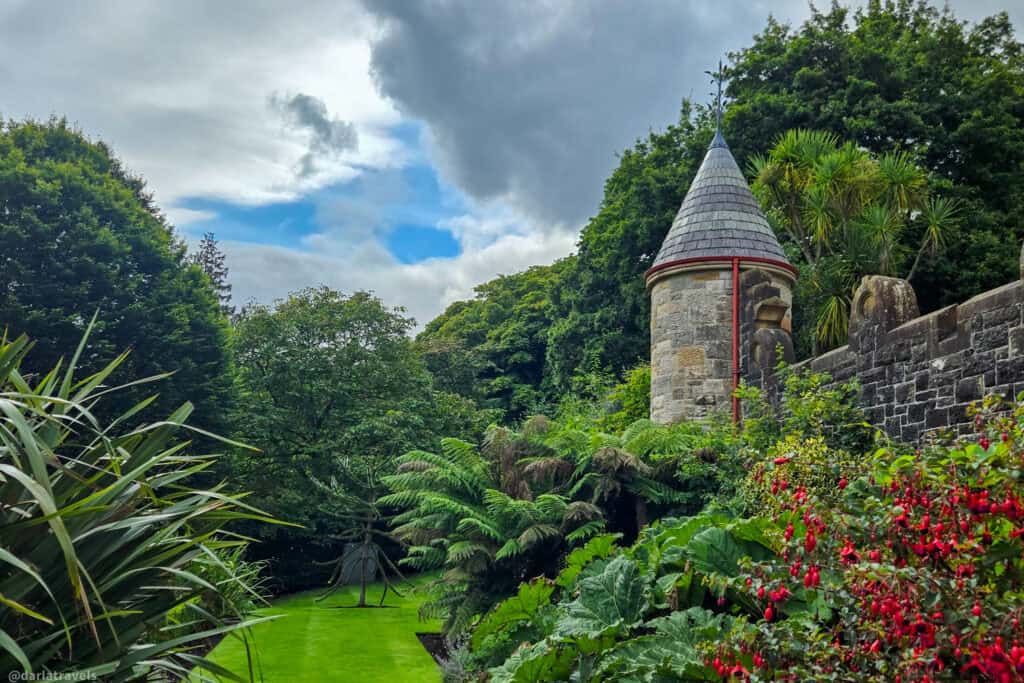
Even if you never searched for a single cat, Belfast Castle is worth a visit for its setting and architecture alone. The building itself has pink Scrabo sandstone walls, asymmetrical towers, turrets, and steep gables that give it a storybook profile against the backdrop of Cave Hill.
On the side fronting the garden, a spiraling stone staircase added in the late 19th century curves down to the lawns, creating one of the most photogenic vantage points on the estate.
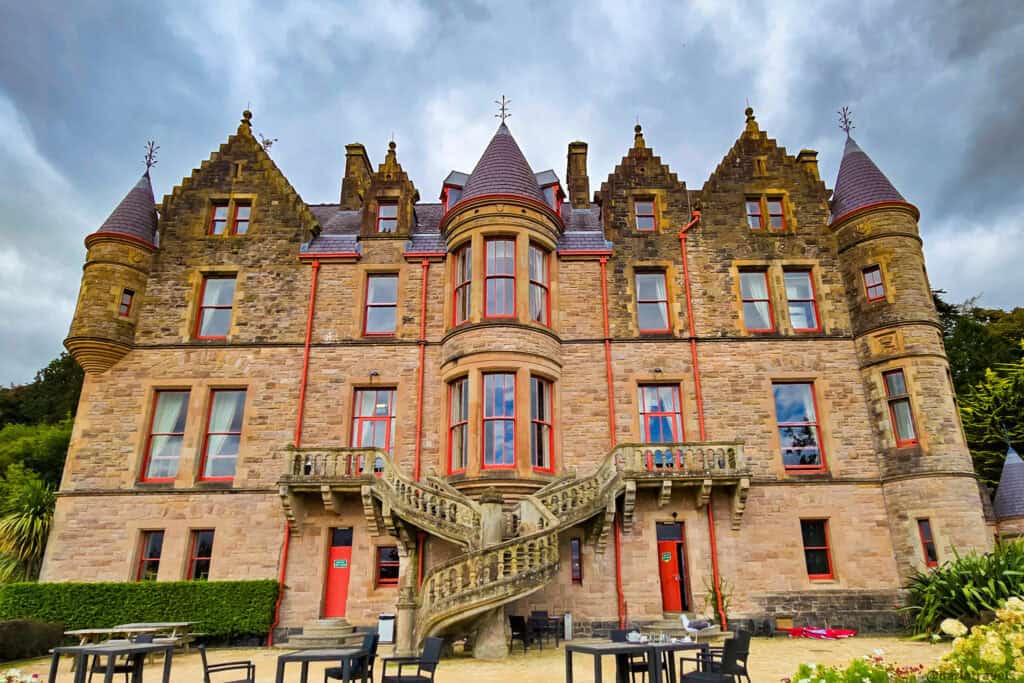
The castle’s location on Cave Hill allows for sweeping views of the city of Belfast below. The Belfast Lough, a long inlet between the Irish Sea and Belfast, features prominently.
Most of the castle is closed to the public, but a few rooms are open for viewing. Look for the Donegall family coat of arms above the main entrance.
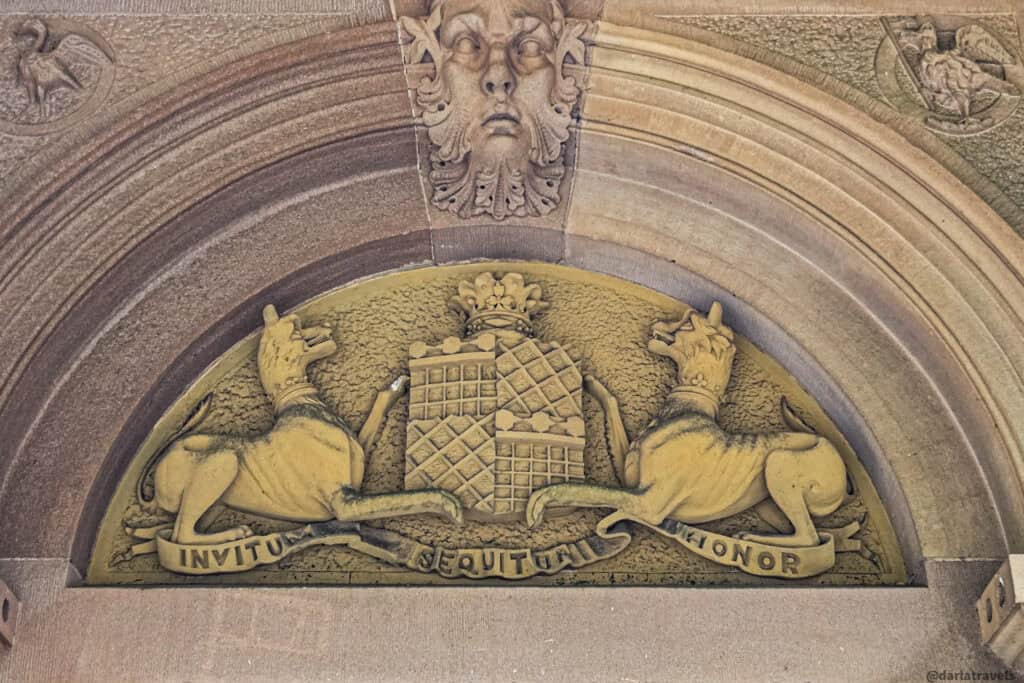
The motto Invictum Sequitur Honor translates as “Honor follows him who does not seek it.”
Inside, the Shaftesbury and Chichester Rooms retain features such as carved oak panelling, fireplaces, chandeliers, and tall windows, allowing views over the gardens and the city below.
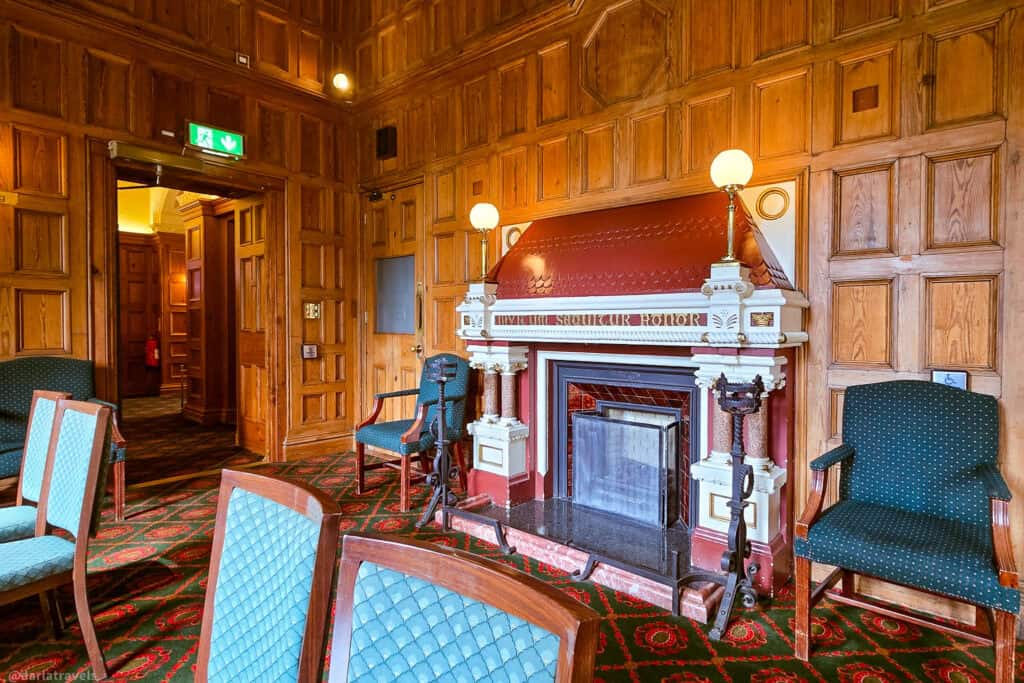
Downstairs contains small exhibits on the park’s folklore and history and on elements of the castle.
Exploring Cave Hill Country Park
Belfast Castle is located within Cave Hill Country Park. The formal landscaping of the castle grounds gives way to the park’s mixed woodland, forest trails, and viewpoints where you can look out over Belfast’s skyline, the docks, and the Belfast Lough, the city’s gateway to the Irish Sea.
The grounds are also home to various wildlife, archeological sites, walking trails, orienteering routes, picnic areas, and a children’s playground, among other features.
The park opens at 7:30 AM daily; closing times vary with the amount of daylight throughout the year.
How to Get to Belfast Castle
Belfast Castle is at Antrim Road, Belfast, BT15 5GR.
The Google Maps Plus Code for Belfast Castle is J3V5+34 Belfast, UK.
Driving and parking
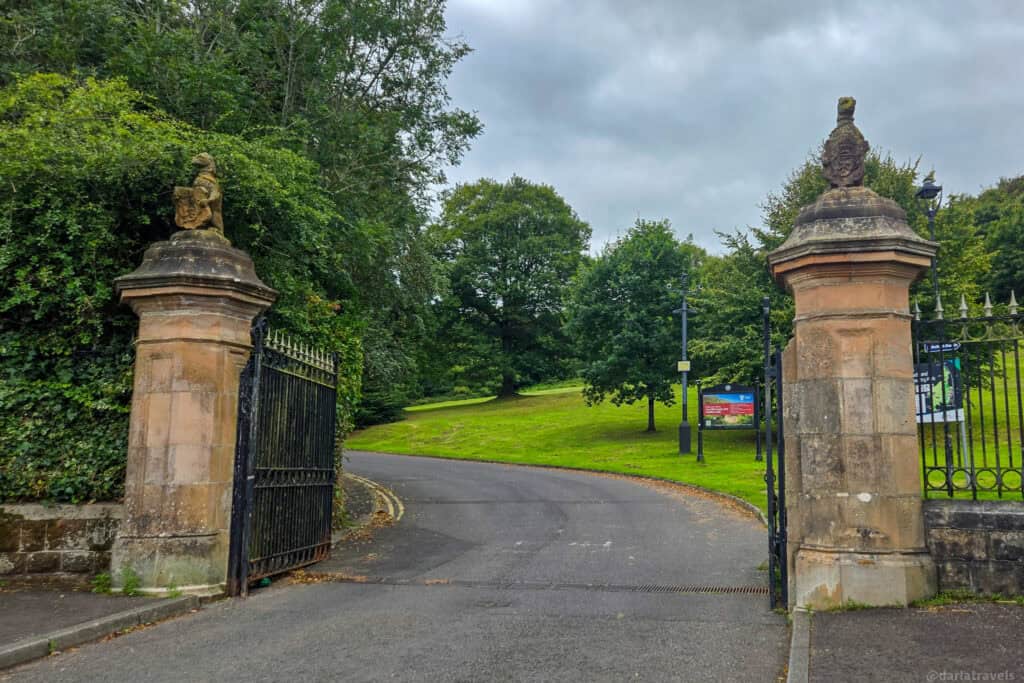
Belfast Castle sits in north Belfast on the Antrim Road, about a 10‑minute drive from the city center. It’s roughly 15 minutes from George Best Belfast City Airport in normal traffic. From Antrim Road, turn into the estate via the Innisfayle Park and Downview Park West entrance, which is clearly signposted for Belfast Castle and Cave Hill Country Park.
Once inside the grounds, follow the internal road uphill to reach the main parking lot in front of the castle. Parking is free.
Via Public Transportation
Take bus number 1 (1a, 1c, 1e, 1f, 1k, etc. ) to the bus stop at the intersection of Antrim Road and Innisfayle Park (Next to the Brew by the Cave coffee shop).
From here, walk up Innisfayle Park. A sign at the last row of houses directs you through a gate to Cave Hill Park and Belfast Castle. Additional signs past the gate provide additional information and a map. Here, take the paved path to the right to get to the castle grounds. You can walk around below the castle and then up and around to the entrance. The terrace overlooking the garden and giving a wide view of Belfast will be just past the castle.
Practical Visitor Information
Belfast Castle is generally open daily, with the castle building open from around 9 am to 6 pm on Sundays and Mondays and until 9 pm from Tuesday to Saturday. However, hours can vary, and parts of the site may close for private events such as weddings.
Admission to Belfast Castle, its gardens, and the visitor information center is free, making it an easy addition to a “things to do in Belfast” itinerary.
Regarding accessibility, the castle interior is fully wheelchair accessible, with an elevator linking the main entrance level to the visitor center, café, function rooms, and garden exit. Accessible parking spots are near the entrance; paths from the car park are step-free; and signage throughout the building is designed to be clear and consistent. Additionally, the formal gardens immediately around the castle are mostly on gently sloping ground.
Food and Drink are also available on the downstairs level. The Tavern Coffee Shop (open 10 am to 5 pm) serves drinks, bakery items, and light bites, while the Cellar Restaurant is open for meals from 12 noon Tuesday through Sunday (Closing times: Tuesday to Thursday, 7 pm; Friday and Saturday, 8 pm; Sunday,6 pm). It features seasonal menus and local ingredients.
Where to Stay Near Belfast Castle
You won’t find a hotel adjacent to Belfast Castle. For most travelers, staying in central Belfast offers the best mix of restaurants and pubs, along with easy access to other attractions like Titanic Belfast and the Cathedral Quarter. The Ramada by Wyndham Belfast City Centre is a practical choice here: it sits right in the Cathedral Quarter overlooking St Anne’s Square, with 165 modern rooms, an on-site restaurant (SQ Bar & Grill), and plenty of bars and live-music venues just steps away. From the Ramada, you can reach Belfast Castle in about 10–15 minutes by car or taxi.
▶️ Watch a video walkthrough of my room at the Ramada here (click).
If you’re in the area of Queen’s University Belfast, the ibis Belfast Queens Quarter is a simple, comfortable hotel with a classic red-brick townhouse exterior. In the Queen’s University area, it’s close to the Botanic Gardens, cafes, and restaurants, and the Botanic train station.
Book the Ramada by Wyndham Belfast City Centre, the ibis Belfast Queens Quarter, or use the map and links below to research and book your Belfast lodging.
GENERIC LINKS
Book now at Booking.com ♦ Book now at Expedia ♦ Book now at Hotels.com
The Cats of Belfast Castle: Pin It for Later!
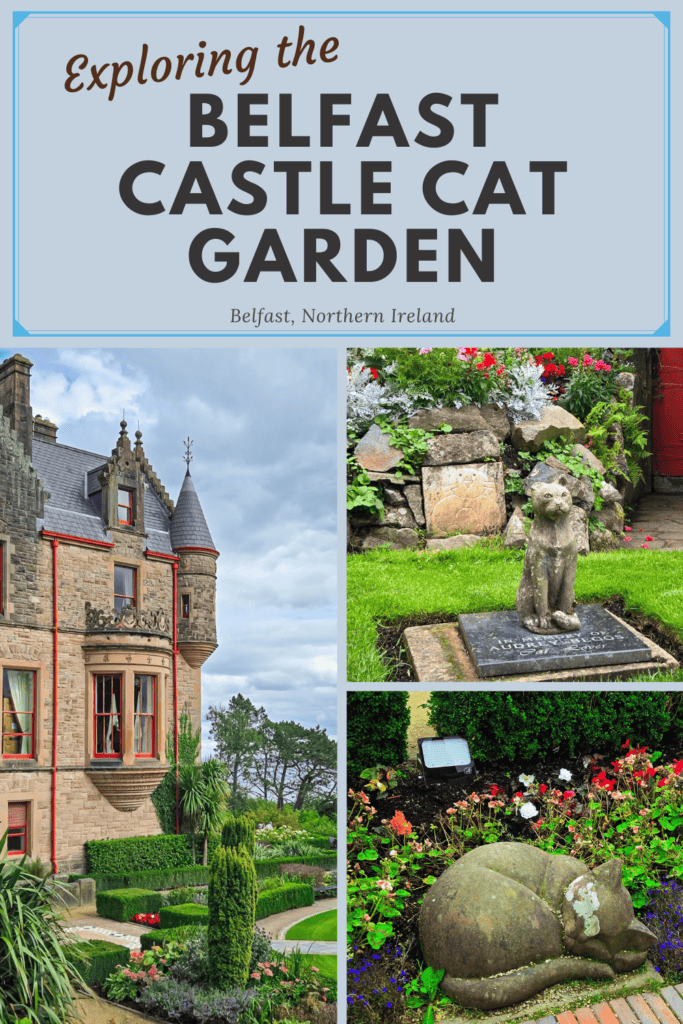
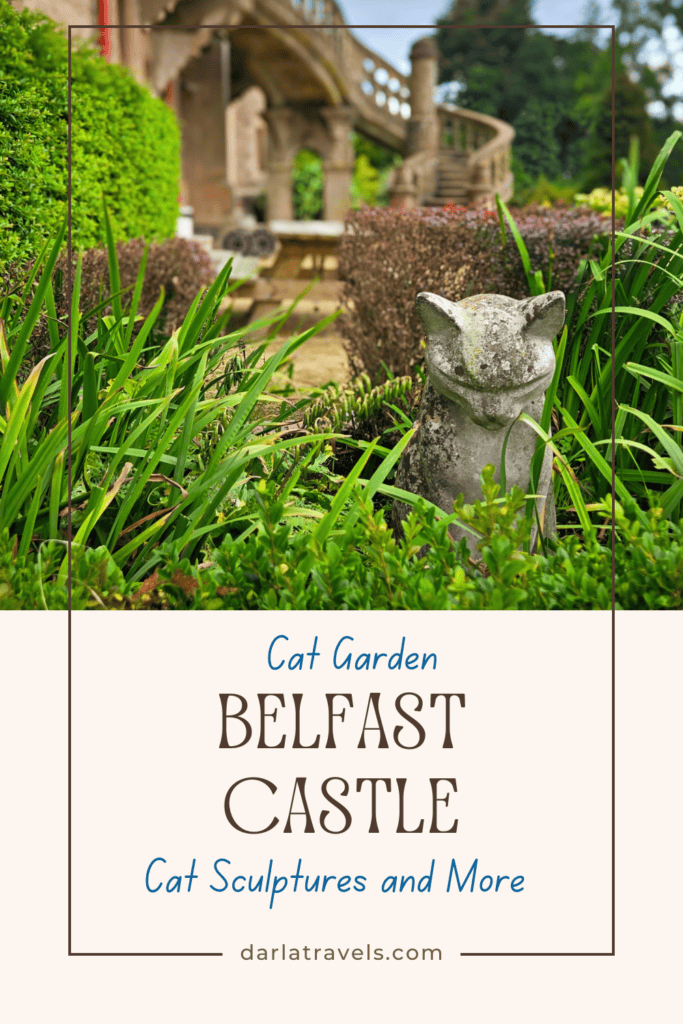
I created these images with the Belfast Castle Cats for your Pinterest boards.
Final Thoughts on Belfast Castle and Its Famous Cats
The Cat Garden at Belfast Castle allows for a low-key survey of the castle exterior and grounds while engaging in a lighthearted quest for cat-themed artworks. The alluring castle, its white cat legend, and city views come together on Cave Hill for a pleasant visitor experience.
Because the castle grounds are free to enter and easy to reach from central Belfast, it’s an easy half-day addition to an itinerary that also takes in city attractions like the Cathedral Quarter, Titanic Belfast, or a walk along the waterfront.
The white cat story adds to the charm and experience at the Belfast Castle. It’s nice to know that visiting the cat gardens is free, making this a perfect addition to a Belfast itinerary.
I agree, it’s hard to argue with adding a free tourist site like this to your list of things to do.
Love the photos! They really bring the castle and its cats to life. I’ve done a couple of trips focusing on castles, though none in Belfast, although it looks like I should put the city on my bucket list.
Glad you enjoyed the article and photos!
My granddaughter has an affinity for cats. I can’t wait to show her this article.
I’m sure families would enjoy exploring the grounds looking for all the cats!
I agree!