- What Is the High Plains Snow Goose Festival?
- What to Expect: Planning Your Snow Goose Festival Itinerary
- My Experience at the High Plains Snow Goose Festival
- Friday Morning: Two Buttes Birding Tour plus the Emick Ranch ($30)
- Friday Afternoon: Lamar Town Tour (free)
- Saturday Morning: Birding tour of Lamar’s Willow Creek (free)
- Saturday Afternoon: Birds of Prey Presentation (free).
- Saturday Afternoon: Sundown Snow Goose Tour ($30)
- Sunday Morning: Sunrise Snow Goose Tour ($30)
- My Summary of the Guided Migration and Local History Tours
- Preparing for the High Plains Snow Goose Festival
- Where to Stay and Eat in Lamar During the Festival
- Pin It for Later- Lamar’s High Plains Snow Goose Festival
- Final Thoughts: Why the Snow Goose Festival Is Worth a Winter Trip to Lamar
Held in and around Lamar, Colorado, the High Plains Snow Goose Festival combines guided tours, educational programs, and local attractions that highlight the snow geese, other birds and wildlife, and special places on the high plains.
Each February, something remarkable happens on the wide-open plains of southeastern Colorado. Tens of thousands of snow geese arrive on fields, reservoirs, and wetlands in Prowers County near Lamar, transforming the quiet winter landscape into a spectacle of sound and motion. Their arrival is the reason birders, photographers, and nature lovers gather for the High Plains Snow Goose Festival, one of the most distinctive winter wildlife events in the state.
If you’re not familiar with snow geese or southeastern Colorado, not to worry. Here is a look at what makes this festival so noteworthy.
** Darla Travels is reader-supported.
When you buy through our links, we may earn a commission. **
Ready to book your Lamar stay for the High Plains Snow Goose Festival? Find a great hotel here:
What Is the High Plains Snow Goose Festival?
The High Plains Snow Goose Festival is one of Colorado’s largest birding festivals, held annually in Lamar, Colorado, around the first week of February.
Where is Lamar, Colorado?
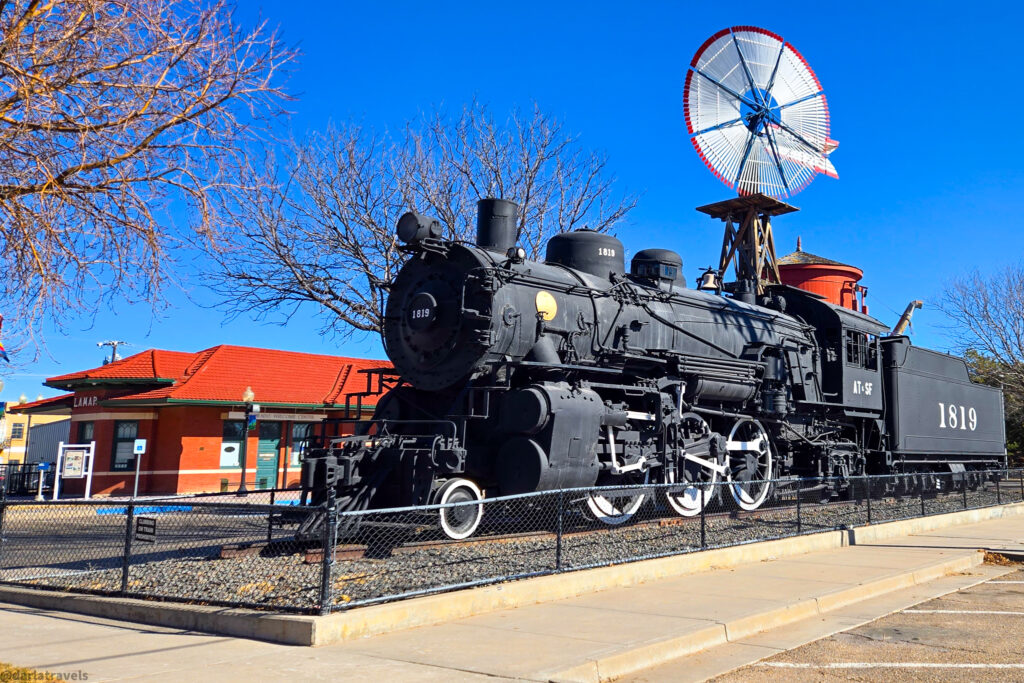
Lamar is located in the southeastern part of the state, sitting on the south side of the Arkansas River floodplain in the Eastern Plains region. It is the largest city in southeastern Colorado, situated roughly 20 miles west of Las Animas, and is the largest community between La Junta, Colorado, and Garden City, Kansas. The city is a transportation hub where US Highways 50, 287, and 385 intersect.
🪧For a deeper look at the region’s history, landmarks, and scenic highlights, see my detailed guide to visiting Lamar, Colorado.
When and Where is the High Plains Snow Goose Festival?
Lamar’s High Plains Snow Goose Festival celebrates tens of thousands of snow geese arriving in early February each year-exact dates vary. The festival typically starts on a Thursday evening with check-in and a hospitality gathering to meet fellow festival-goers. Tours and presentations take place on Friday and Saturday, and Sunday morning.
Why Lamar is an Important Snow Goose Migration Spot
Lamar sits along the Central Flyway, one of North America’s major bird migration corridors.
Snow geese are long-distance migrants. They travel thousands of miles each year, flying from their Arctic breeding grounds to warmer areas farther south in the winter and back again. From the south, they move northward in February and March, relying on open habitats where they can rest and refuel. And the agricultural fields, reservoirs, and wetlands of Prowers County provide exactly what they need:
- Grain in fields, left over from the harvest, provides nourishment.
- The geese roost on open water, which is important for their hygiene, hydration, and protection from predators on land.
- Finally, the high prairie provides expansive sightlines that provide additional protection against those predators.
These conditions make the region especially attractive during migration season, even though the surrounding landscape may appear stark at first glance. Clearly, southeastern Colorado is a crucial stopover point during late winter migration.
What to Expect: Planning Your Snow Goose Festival Itinerary
The High Plains Snow Goose Festival takes place in early February and has delighted visitors for over 20 years. It features guided birding tours, local history, wildlife education, and relaxed social gatherings.
- Events typically span two and a half days, plus an evening for check-in.
- Events are spread across Lamar and the surrounding areas, with options ranging from short walks to half-day bus tours.
- Lamar High School functions as the Festival Headquarters.
The schedule of events varies somewhat each year. The following is a general outline of the types of events, talks, and tours offered by the festival organizers in the past. Consult the official High Plains Snow Goose Festival website for up-to-date information. The Festival also has a Facebook Page. Many tours have fees, as noted below.
With the participation of local experts, historians, and wildlife officers, the Festival offers tours and activities for every kind of adventurer:
- Snow Goose Tours ($FEE): The festival offers several field trips to see snow geese, including sunrise and sunset tours.
- Other Birding and Wildlife Tours
- Local Birding Hotspots (Free): Lamar hosts over 400 species of birds throughout the year. Local festival field trips right in town include the riparian area around Lamar’s Willow Creek and the Valco ponds at North Gateway Park.
- Two Buttes Reservoir ($FEE) is another field trip location for attendees to see multiple bird species and other wildlife abundant in southeast Colorado.
- The Wild Animal Refuge ($FEE) is a private wild animal sanctuary.
- Local Culture and History: The event also includes non-birding tours. Past locations have included:
- Local bus tours of Lamar, plus stepping back in time at the Big Timbers Museum. Free.
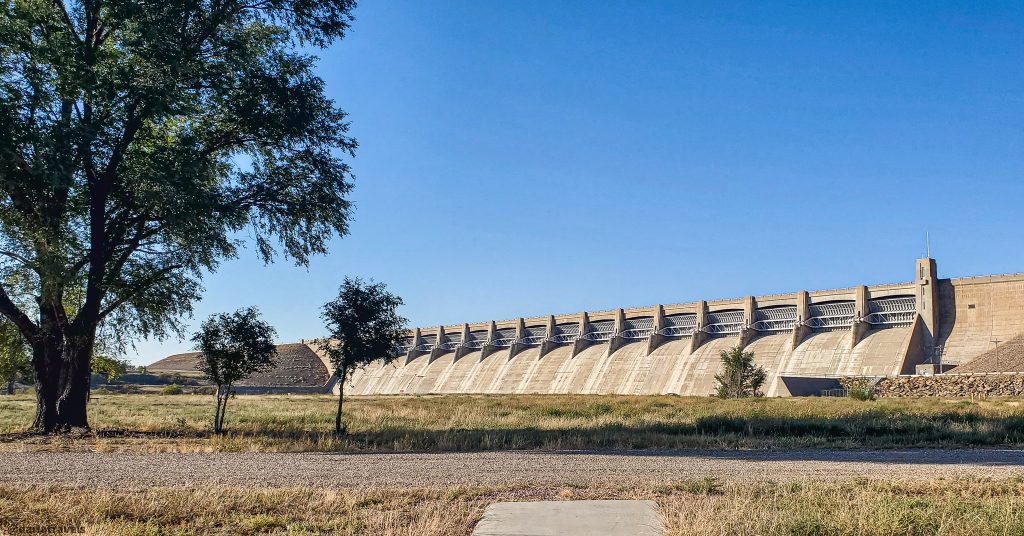
- Interpretive tour of the historic John Martin Reservoir Dam, hosted by the U.S. Army Corps of Engineers. Free
- Boggsville Historic Site, location of the first permanent, non-military outpost in southeastern Colorado. Free
- Amache National Historic Site (Granada Relocation Site) learning about the historic 1927 Buick owned by the infamous Fleagle Gang, and finding out how a local bank robbery made FBI history.
- Colorado Mills, a local manufacturer of Sunflower Oil. Free
- Educational Talks: Presentation topics range from birding to local history to the geology and ecology of southeastern Colorado; many talks are free. Previous topics include:
- Bird migration, birds of prey, pelagic birding, bird conservation
- Birds of Prey talk with rescued birds, including hawks, eagles, and owls, from the Raptor Center in Pueblo, Colorado.
- History of Camp Amache, a historic Japanese internment camp in nearby Granada, CO.
- History of Bent’s Old Fort, an important Santa Fe Trail trading post west of Lamar.


My Experience at the High Plains Snow Goose Festival
I wanted to sign up for every tour at the High Plains Snow Goose Festival, but of course, I couldn’t be in two places at once, and I didn’t have limitless energy.
After selecting the birding tours I wanted to attend, I filled in my free time with local history and cultural experiences. I found the festival to be exceptionally well organized, with knowledgeable guides and punctual transportation. And every outing offered a new opportunity to learn more about this fascinating corner of Colorado.
Friday Morning: Two Buttes Birding Tour plus the Emick Ranch ($30)
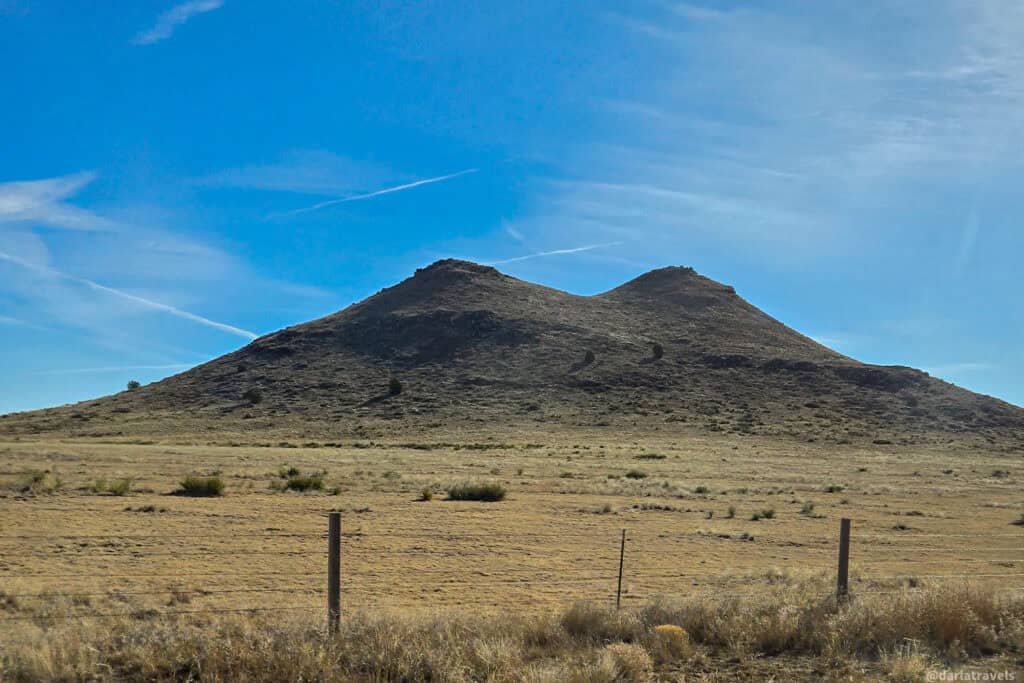
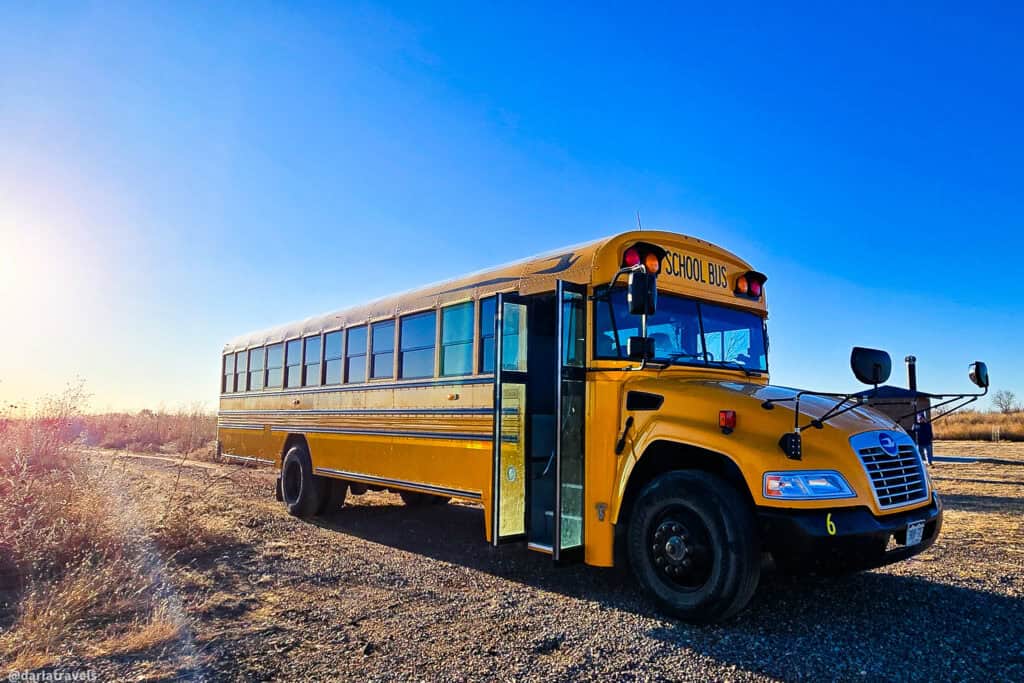
The weekend kicked off at 7:00 a.m. as our tour bus, a yellow Lamar school bus, rolled away from Lamar High School. Led by birding expert Debbie Barnes-Shankster, we headed south toward the Two Buttes State Wildlife Area (SWA). Just north of the wildlife area, it was easy to spot the highest point in Prowers County, the double-peaked Two Buttes mountain, rising about 300 feet (91 m) above the surrounding plains to an elevation of 4,711 ft (1,436 m).
Now in Baca County, we made a quick stop at the mostly dry reservoir before traveling to the other side of the dam, where we walked through a stunning red sandstone box canyon. This area features a deep pond known locally as the “Black Hole,” popular with locals for swimming. Overall, we covered about 2.2 miles (3.7 km) on this birding excursion.
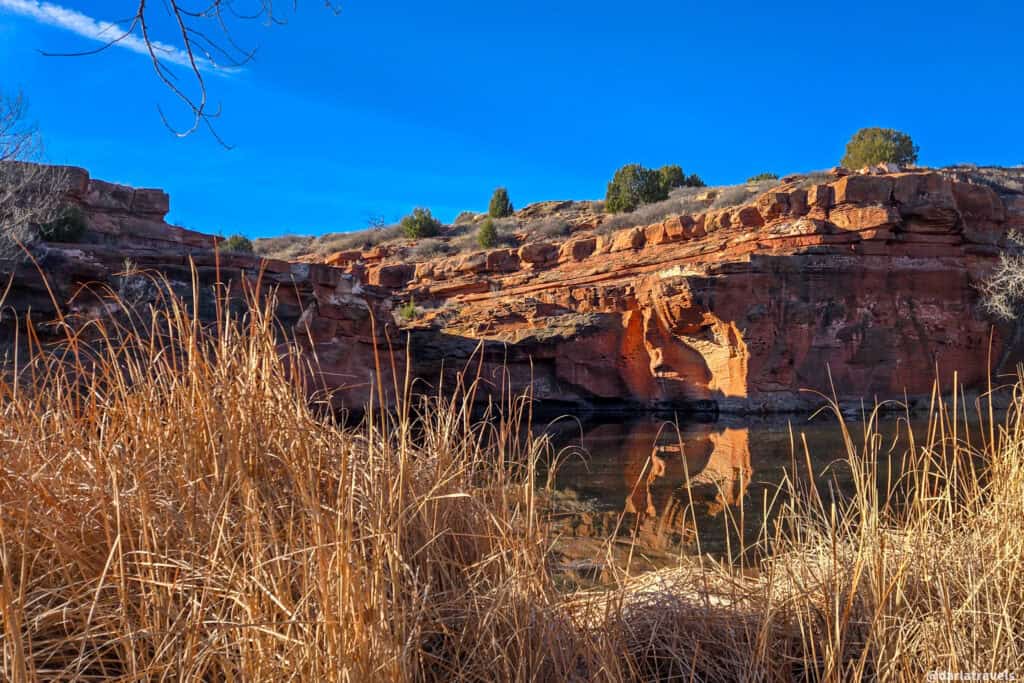
It was pretty amazing to see such a beautiful canyon so close to Two Buttes Mountain, both features set in the middle of the otherwise flat and somewhat monotonous plains.
👣 In fact, there are multiple canyons of note in southeastern Colorado. For example, see my article about hikes in southeastern Colorado’s Picketwire Canyon and Vogel Canyon (Comanche National Grassland).
Back to the tour, the birding did not disappoint. We spotted Northern Harriers, American Kestrels, Mountain Bluebirds, Western Meadowlarks, and two kinds of Sparrows. There were several highlights here: Watching a wild turkey fly directly over the canyon and spotting a porcupine wedged high up in a tree. Both sights were nothing I expected, and thoroughly delightful.
Visiting the Emick Ranch
On this tour, we were lucky to be joined by local rancher David Emick and his wife, Donna. The Emick Ranch is the site of the Hasser Family Homestead, dating from 1918. With a family presence in the area for over 100 years, the Emicks had a wealth of knowledge on the landscape, local history, and changing land and agricultural practices.
The main reason for our stop at the ranch was to view the family’s enormous collection of beautifully restored antique windmills. Housed in a massive 9,000-square-foot (836-sq-m) barn museum, it’s one of the largest private collections of historic windmills in the United States. David’s parents first restored their first windmill in 1982. This initial project became a hobby, then a passion. There are about 45 windmills at the ranch today.
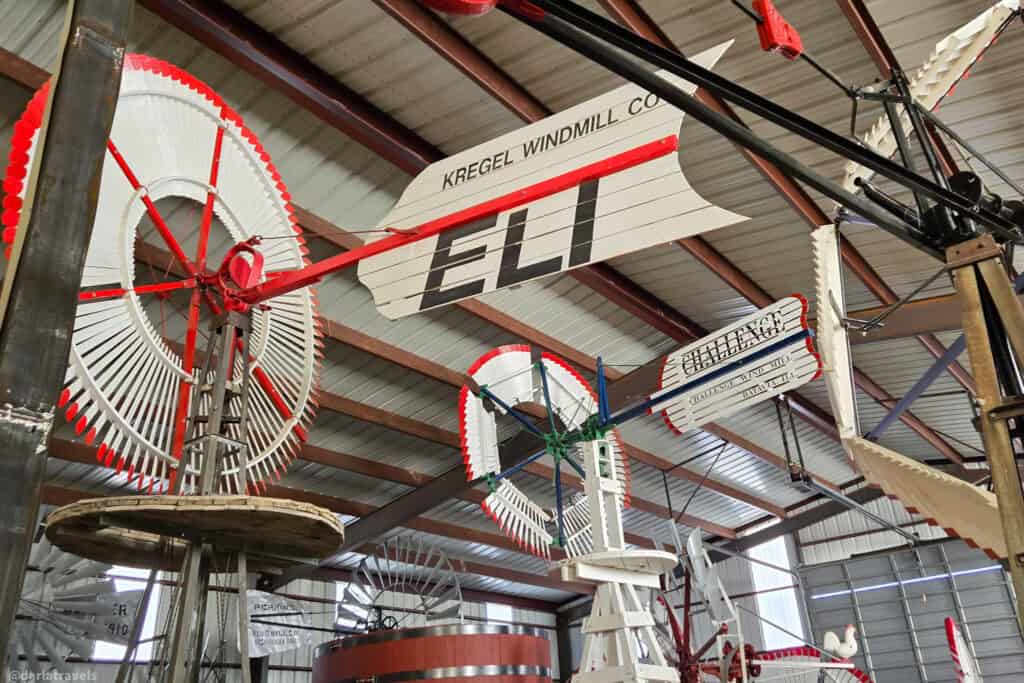
As a former patent attorney, I was fascinated to learn that many of the restorations were completed using details found in original patent documents. David’s father, Bob, painstakingly recreated the missing parts using the same wood species and construction methods as the original manufacturers. The windmills have even been painted in historically accurate colors.
The family’s collection became so extensive that the first 40 or so restored windmills were transferred to the American Windmill Museum (formerly the American Wind Power Center) in Lubbock, Texas. If you’ve seen the windmill at Lamar’s Welcome Center (4th & Beech St.), you’ve already seen one of the Emicks’ restorations.
I was extremely grateful not only to see the windmills but also to learn about the vital role they played for settlers on the plains, using wind energy to pump water for irrigation of the dry prairie.
Friday Afternoon: Lamar Town Tour (free)
After a morning in the field, I joined one of several free Lamar Town Tours, which departed from the Big Timbers Museum ( 7515 US 50).
The one-hour minibus tour provided an excellent overview of Lamar and its history. We visited several community landmarks, including Memorial Park and the Lamar Welcome Center, while learning about public art, transportation options, and the city’s role as a regional hub.
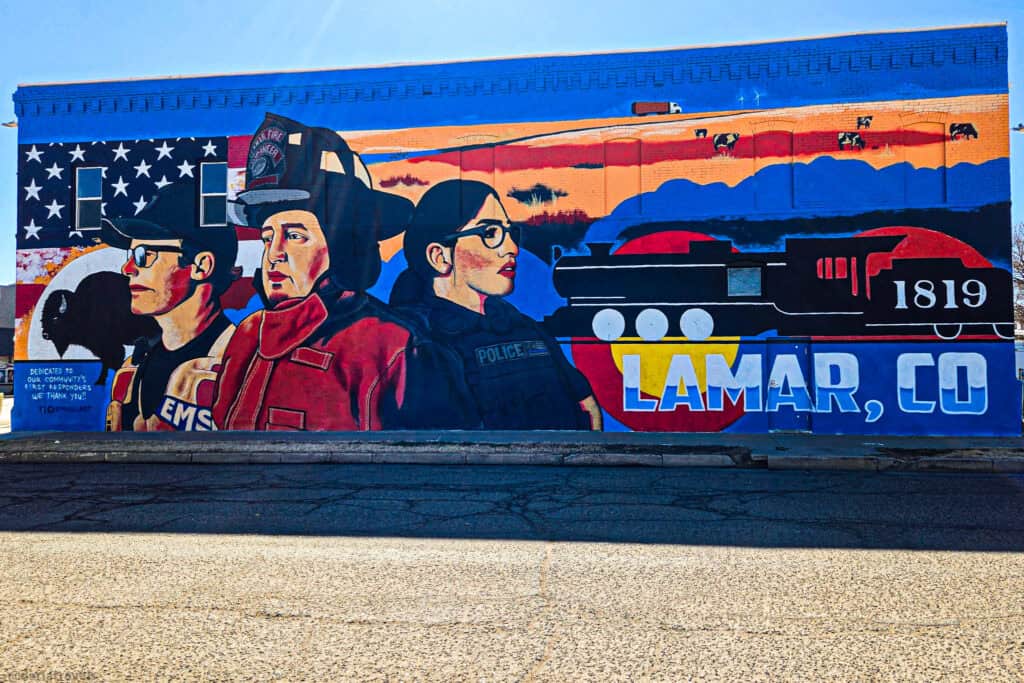
If you want to understand the town beyond the birding tours, this is a nice complement to the festival’s outdoor excursions.
For more on Lamar’s history, landmarks, and scenic highlights, see my detailed guide to visiting Lamar, Colorado.
Saturday Morning: Birding tour of Lamar’s Willow Creek (free)
Saturday morning’s bird walk offered a slower pace and a chance to experience one of Lamar’s local nature areas.
Led by Lamar resident Dotti Russell, the walk followed easy trails through the Willow Creek Nature Area adjacent to the north end of Lamar Community College. The route covered less than a mile (about 1.3 km), making it accessible for most participants.
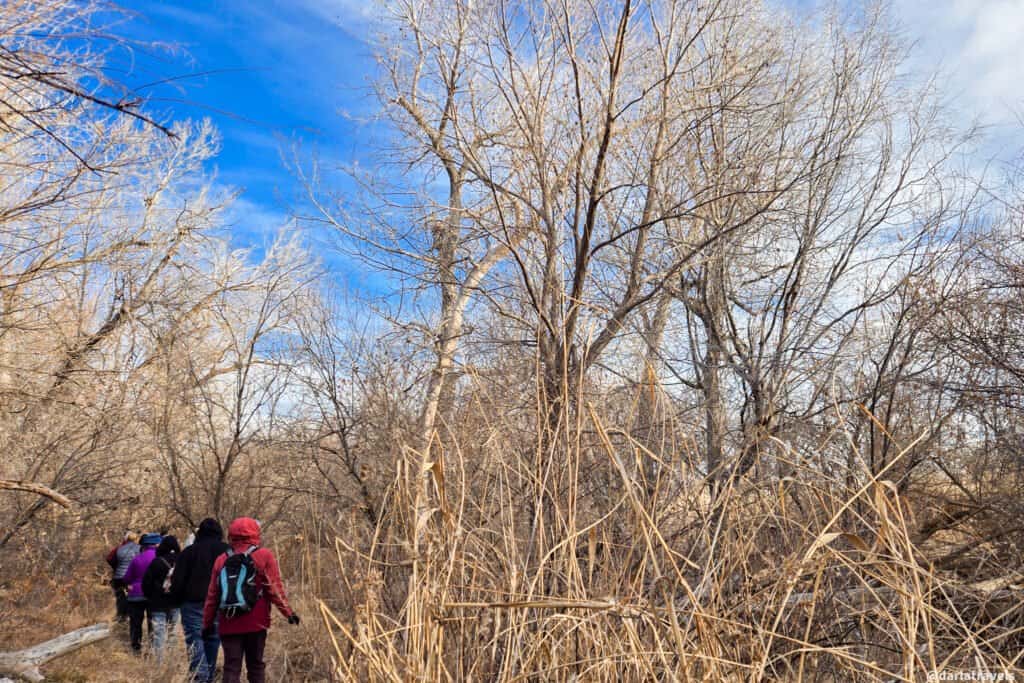
Although the walk was relaxed, the birding was rewarding. We spotted towhees, juncos, bluebirds, robins, starlings, white-winged doves, and several wild turkeys, including one that landed in a tree. My favorite sighting was of Cedar Waxwings. Their soft colors, sleek appearance, and bright yellow tail tips made them one of the most beautiful birds I saw all weekend.
Saturday Afternoon: Birds of Prey Presentation (free).
Before heading back into the field for the afternoon snow goose excursion, I spent part of Saturday afternoon at the Lamar High School auditorium (located at 1900 South 11th Street) for one of the festival’s most popular educational programs from the Nature & Wildlife Discovery Center’s Raptor Center in Pueblo. This free program gave attendees a rare opportunity to see several live birds of prey up close while learning about their behavior, adaptations, and conservation.
One of the birds was a Turkey Vulture, a species many people see soaring overhead but rarely get to observe up close. Being scavengers, these birds have some repulsive behaviors, yet I found myself charmed by Lurch, the rescued Turkey Vulture on Diana’s arm.
Unfortunately, I had to leave the presentation a little early to join the afternoon Snow Goose Tour, but what I did see was both educational and memorable, an excellent complement to the festival’s field excursions.
Saturday Afternoon: Sundown Snow Goose Tour ($30)
The festival’s signature experience is seeing thousands of migrating snow geese, and Saturday afternoon’s tour delivered exactly that.
Our bus departed Lamar High School at 2:00 p.m. and headed to the Midwestern Farms Tract of the Granada State Wildlife Area, a 5,630-acre (2,278-ha) property managed by Colorado Parks and Wildlife.
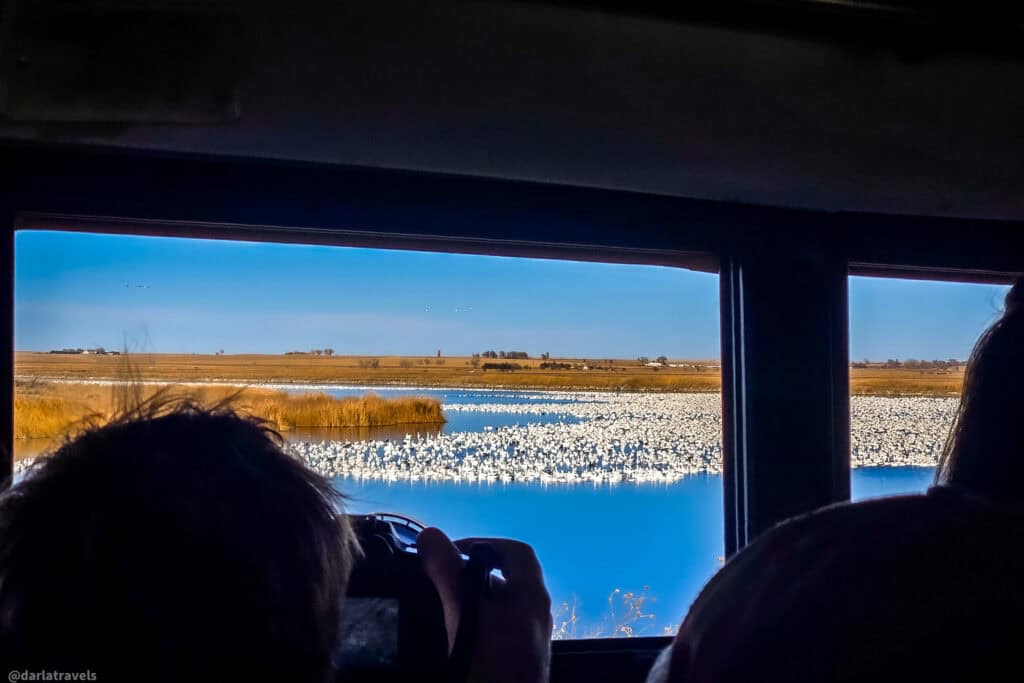
Once again, Debbie Barnes-Shankster served as our guide. She explained that snow geese are extremely wary of people, so we initially used our tour bus as a mobile blind. Even at a distance, the birds remained alert and frequently moved farther away when they sensed disturbance. So seeing the snow geese required patience.
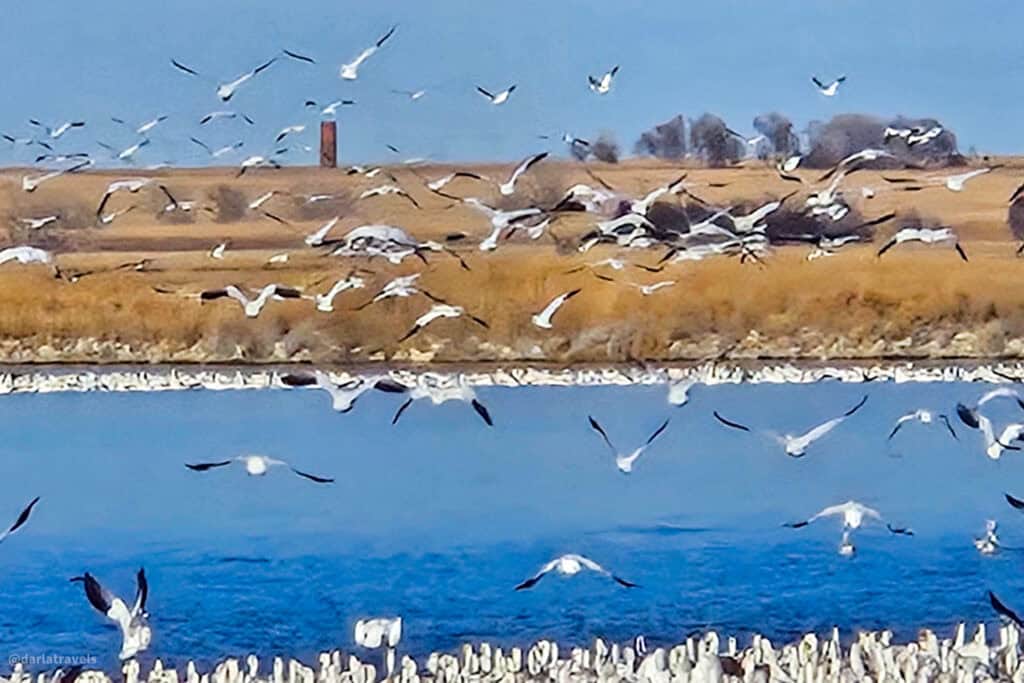
The effort was worth it. We observed an estimated 25,000 to 40,000 snow geese gathered on a large pond. Most displayed the familiar white plumage, although we also spotted a few of the rarer blue-morph snow geese mixed into the flock.
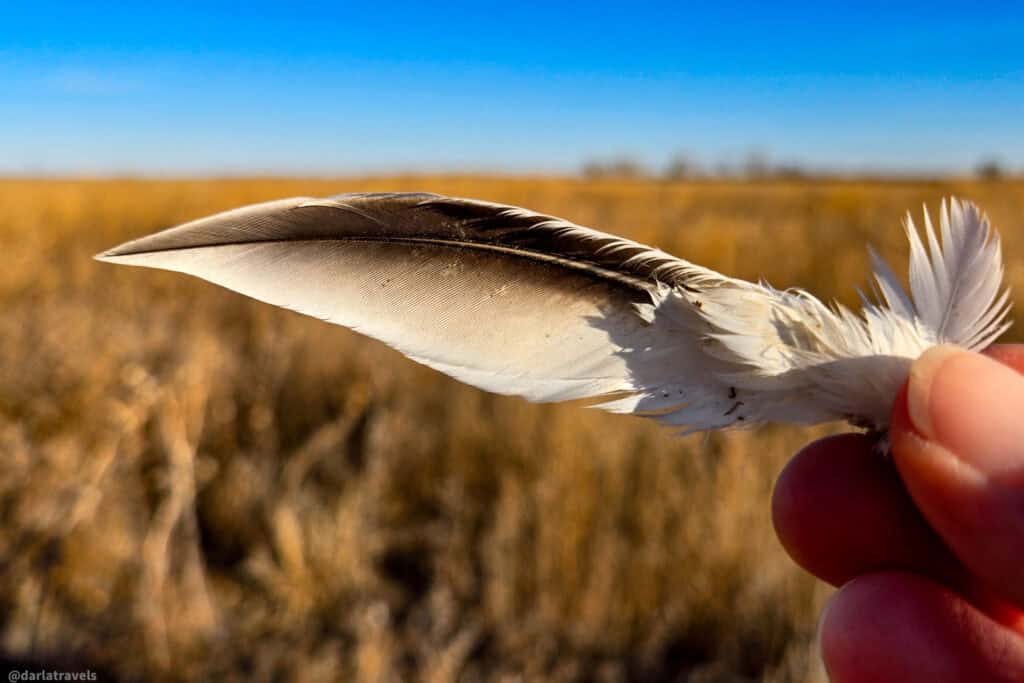
The wetlands support a wide variety of other birds, and, in addition to the snow geese, we observed many of them. Among the species we spotted were Ross’s Geese, Canada Geese, Mallards, American Coots, Great Blue Herons, Northern Harriers, Bald Eagles, and Red-tailed Hawks.
Sunday Morning: Sunrise Snow Goose Tour ($30)
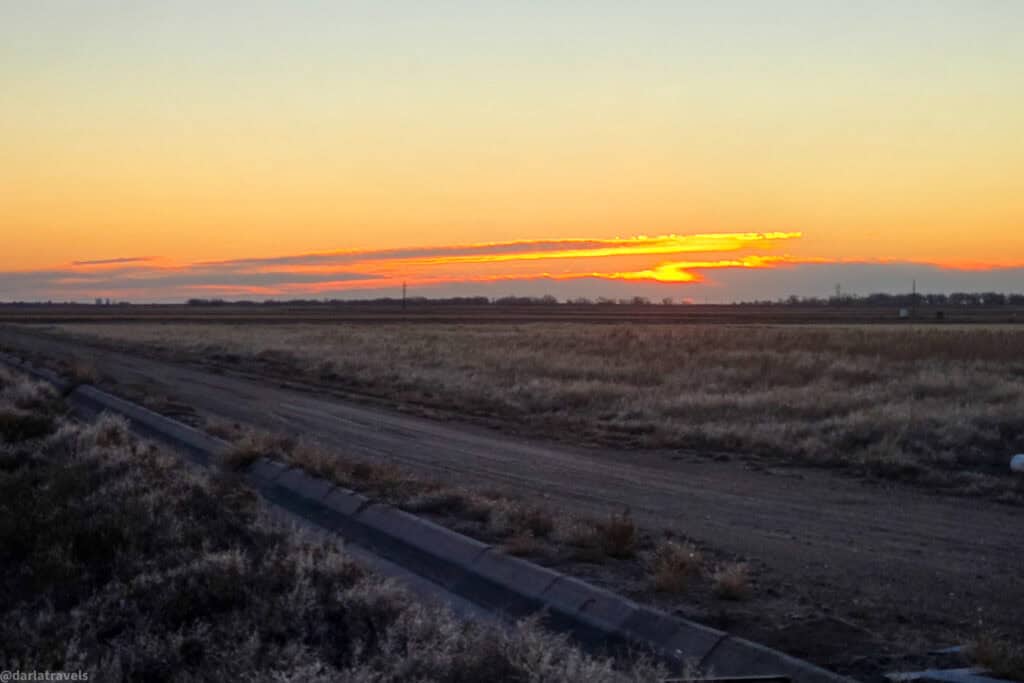
My final excursion, and the festival’s last event, began well before dawn on Sunday morning. We left Lamar High School at 5:30 a.m. for a sunrise snow goose tour led by Kevin Kaczmarek from Colorado Parks and Wildlife.
We returned to the Midwestern Farms ponds but approached the geese from a different area. While waiting in the darkness, a westbound Amtrak Southwest Chief train rolled past us, adding a memorable touch to the morning.
As daylight emerged, we could see approximately 30,000 snow geese resting on the water. Kevin explained how once-endangered snow goose populations have rebounded dramatically over the years. One reason is the high number of wheat fields enabled by modern agriculture: they provide abundant food during migration in the form of “leftovers” on the harvested fields. He also discussed challenges facing the birds today, including avian influenza.
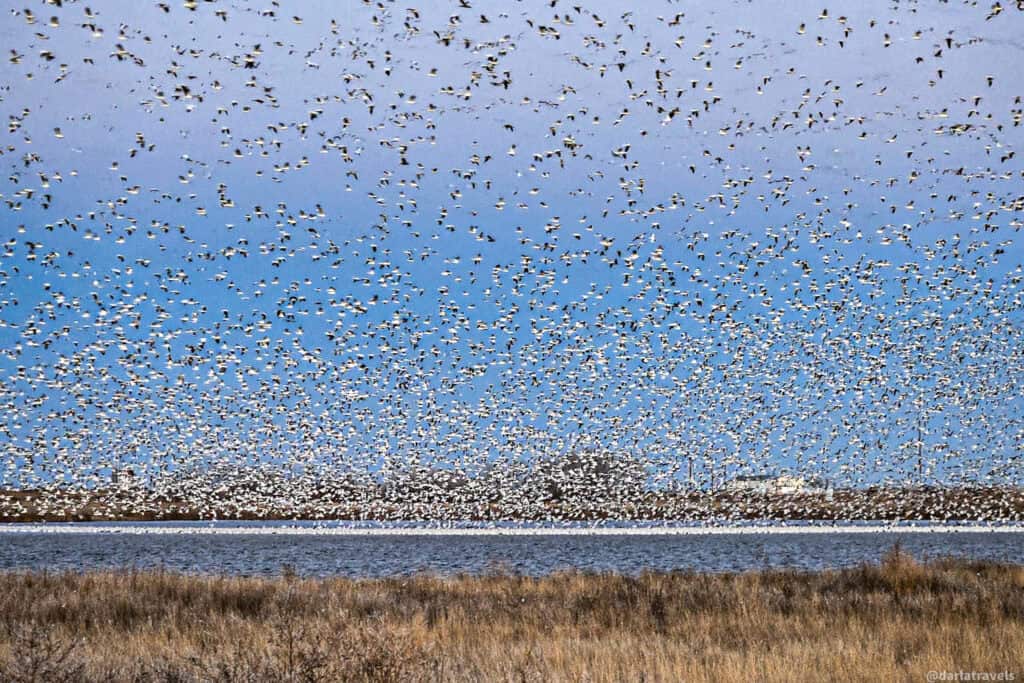
Again, we stayed inside the bus or near it to avoid disturbing the flock.
After a night of roosting on the lake, the birds were ready to take flight and find their morning meal. It sounds like a cliche, but the spectacle was truly unforgettable.
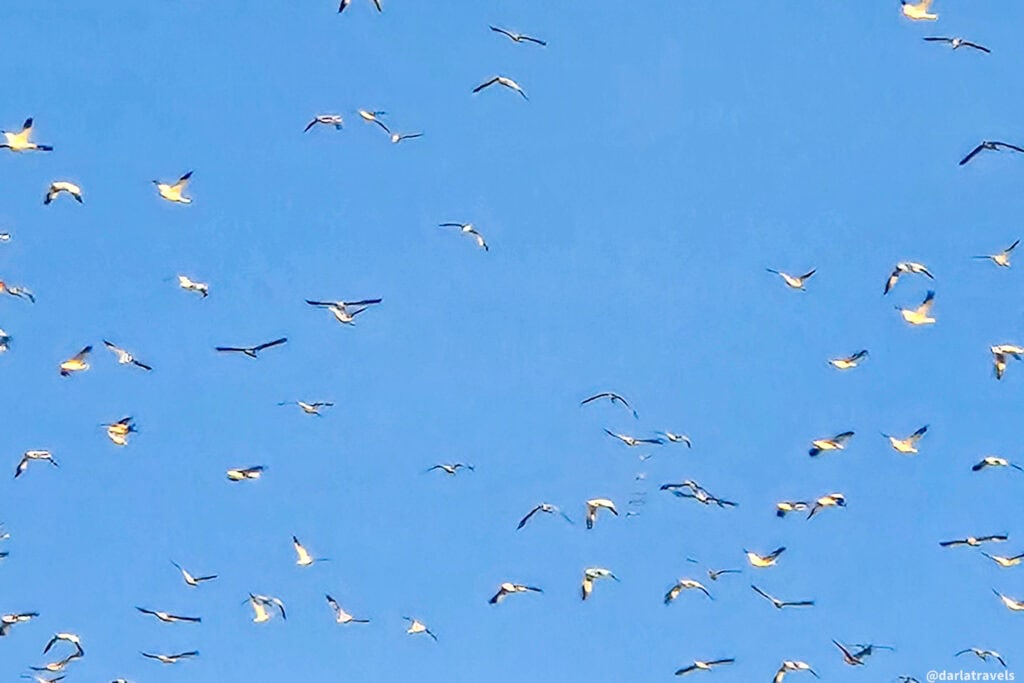
Shortly after sunrise, the snow began rising from the lake. After a slow start, a large number seemed to take flight all at once, swirling above the pond in giant spirals that resembled a living tornado. The sound was just as impressive as the sight. The constant chorus of calls from tens of thousands of birds created an incredible natural soundtrack.
Watching so many birds maneuver together without colliding was remarkable. Eventually, the geese began to fly away, and a short time later, only a few stragglers were left.
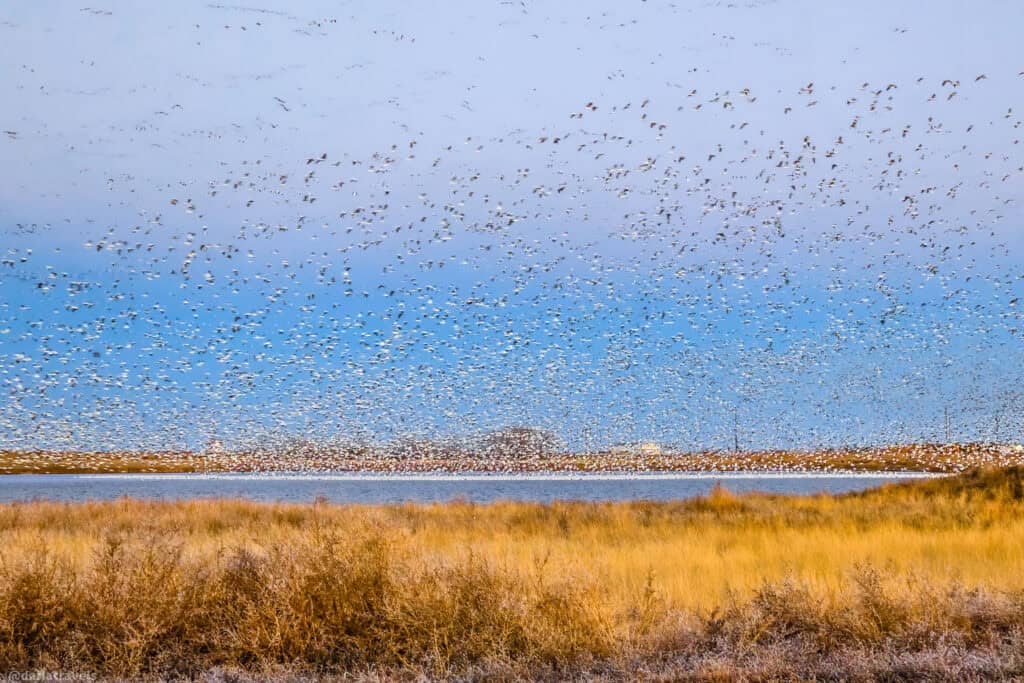
Video of Snow Geese at Sunrise
On our return trip, the wildlife viewing continued. Kevin noted that Bald Eagle populations have been steadily increasing in southeastern Colorado, and we stopped at an active Bald Eagle nest that had been occupied for the past three years. The eagle pair was perched nearby rather than in the nest, something Kevin found somewhat concerning. One eagle eventually flew toward the ponds, giving us a nice show.
On our return route, we also stopped at a harvested wheat field to watch snow geese feeding, moving across the ground in a hopscotch-like pattern as they searched for leftover grain.
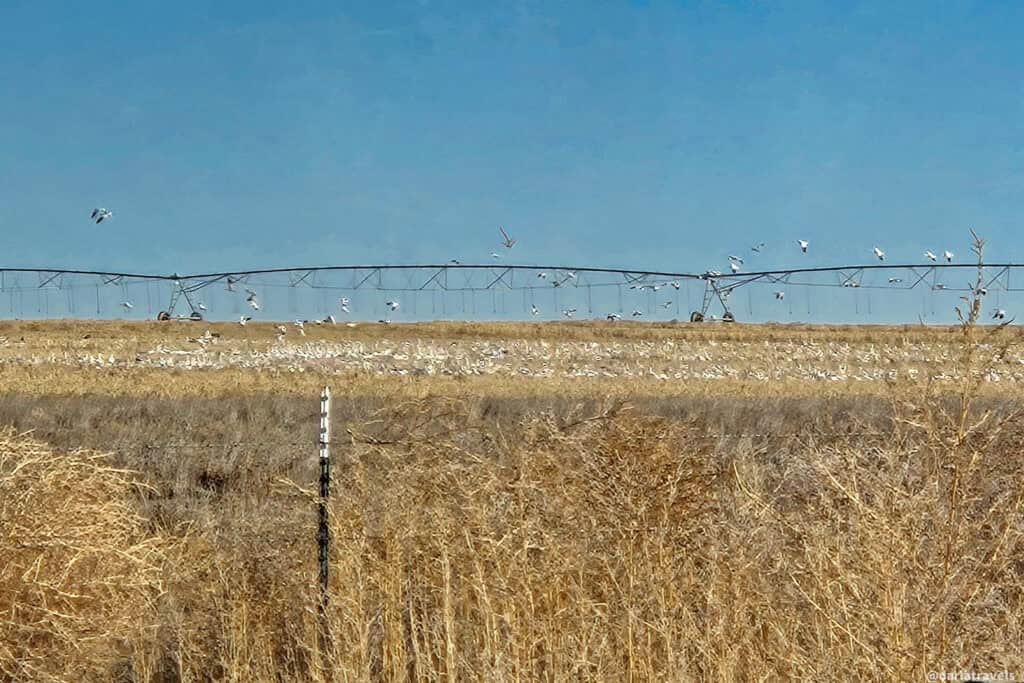
While we waited here, Kevin’s colleagues were out searching for additional birds for us to see. After some back and forth on the radio, we drove down a few county roads in search of Scaled Quail, but none revealed themselves. On the other hand, we were able to spend some time viewing a few pheasants and a flock of Rio Grande Wild Turkeys.
My Summary of the Guided Migration and Local History Tours
As a beginning birder, I found the guided birding tours at the High Plains Snow Goose Festival to be a treat. The birding excursions provided access to places I never would have known to visit on my own. At the same time, the local guides added valuable context about wildlife behavior, migration patterns, ranching history, and conservation efforts.
I’ll also point out that more experienced birders on the tours were generally kind and helpful. They pointed out distant birds, shared their spotting scopes, and helped with bird identification.
What impressed me most was the diversity of experiences. In a single weekend, I explored a hidden canyon landscape, watched tens of thousands of migrating snow geese, learned about the restoration of historic windmills, and gained a deeper understanding of life on Colorado’s High Plains.
Preparing for the High Plains Snow Goose Festival
Who Should Attend This Winter Wildlife Event?
The High Plains Snow Goose Festival will appeal to birders and other travelers who value experience over spectacle.
- Nature lovers and casual birders will find the festival especially rewarding. You don’t need prior birding experience to enjoy watching thousands of snow geese move across the landscape, and the guided tours make sighting and watching the birds easy.
- Photographers will find many opportunities during the snow goose festival. There are endless photo possibilities with the combination of open plains, shifting light, and large flocks, particularly at sunrise and sunset. The scale and movement of the migration are dramatic.
- Travelers who enjoy educational, low-key events will appreciate southeastern Colorado’s quiet atmosphere. The festival is not a crowded or commercialized event, but rather a thoughtfully organized gathering focused on learning, conservation, and connection to place.
- Those open to flexibility will get the most out of the experience. Because migration depends on weather and environmental conditions, no two festivals will be the same.
In short, whether you’re a serious birder, a nature photographer, or simply someone who enjoys discovering lesser-known destinations, the High Plains Snow Goose Festival offers an engaging and educational way to experience southeastern Colorado.
Festival Registration
The High Plains Snow Goose Festival has a flexible, à la carte registration format. General festival registration is free.
After registering at the official High Plains Snow Goose Festival website, you can customize the experience based on your interests, schedule, and budget. Choose from a variety of guided birding tours, wildlife-viewing excursions, educational presentations, and local history programs like those detailed above. Whether you attend a single program or fill your entire weekend with activities, you only pay for the individual tours and programs you select.
⚠️When registering, be sure to note the strict cancellation and no refund policies.
Do You Need a Colorado State Wildlife Area Pass?
Because the snow goose tours (and certain other tours) visit a Colorado State Wildlife Area (SWA), participants must carry one of the following:
- A valid Colorado State Wildlife Area Pass
- A current Colorado hunting license
- A current Colorado fishing license
🕐Make sure to purchase your SWA pass or hunting/fishing license before arriving for your excursion.
Keep in mind that a Colorado State Parks Pass or the Keep Colorado Wild Pass does not satisfy this requirement.
The annual SWA pass costs less than $50 and is valid through March 31 of the license year, making it a good value if you plan to visit Colorado wildlife areas throughout the year.
Where to Buy a Colorado SWA Pass
Purchasing an SWA pass is simple and can be done online, by phone at 1-800-244-5613, or at authorized license agents across Colorado.
If you’re arriving in Lamar before the festival, you can purchase a pass at:
- Big R of Lamar (8723 E. Highway 50)
- Colorado Parks and Wildlife Lamar Office (2500 South Main Street)
- Walmart (1432 East Olive Street)
I purchased my pass online before the festival and was able to access it in a couple of days through the MyCPW mobile app.
Winter Birding Gear: What to Pack for February in Colorado
If you’re attending the High Plains Snow Goose Festival in February, be prepared for a wide range of weather conditions. Winter on Colorado’s High Plains can deliver frosty mornings, brisk winds, bright sunshine, and surprisingly mild afternoons.
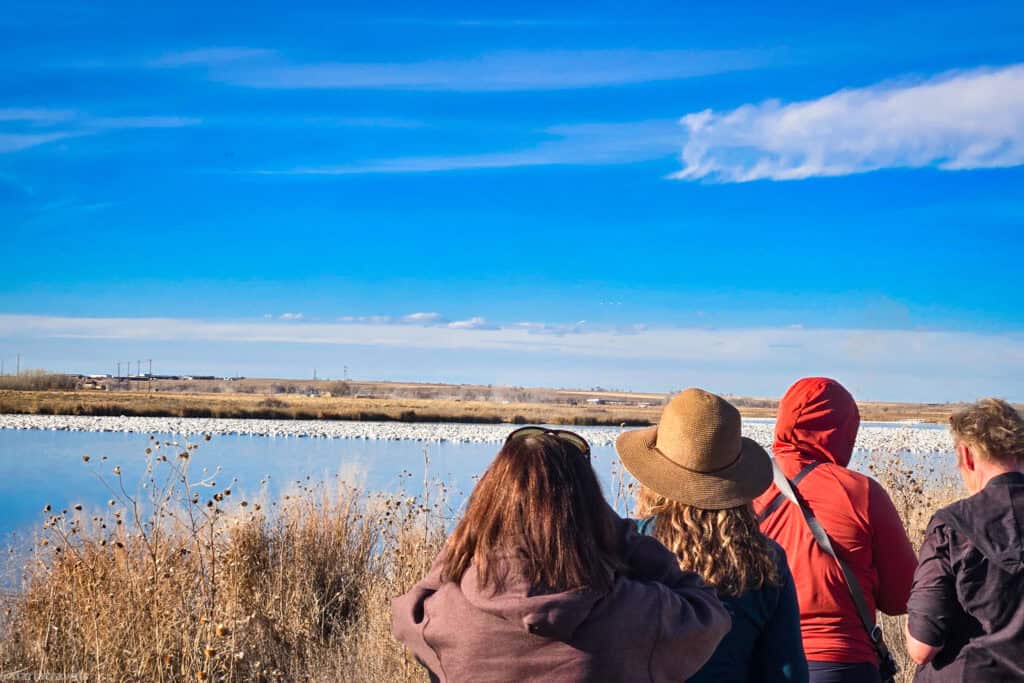
The average February temperature in Lamar is around 34°F (1°C).
- Typical highs reach 52°F (11°C).
- Overnight lows dip to 22°F (-6°C).
- Snow is possible, but major snowstorms are not the norm. February averages just 1.4 inches (3.6 cm) of snowfall.
- Skies are clear more often than not.
Dress in Layers for Changing Conditions
So flexibility and layering are key to comfort. Bring warm winter clothes with removable layers as the day warms up. I recommend wearing temperature-regulating fabrics like merino wool to avoid getting too cold in the mornings or too warm in the afternoons. Suggestions include:
- Insulated touchscreen gloves
- A warm winter hat
- Warm socks
- Good outdoor walking shoes
- A wind-resistant jacket.
Essential Birding Equipment
Things to bring for a good birdwatching experience include binoculars and spotting scopes. Camera gear is optional, but good photos may enhance your festival experience.
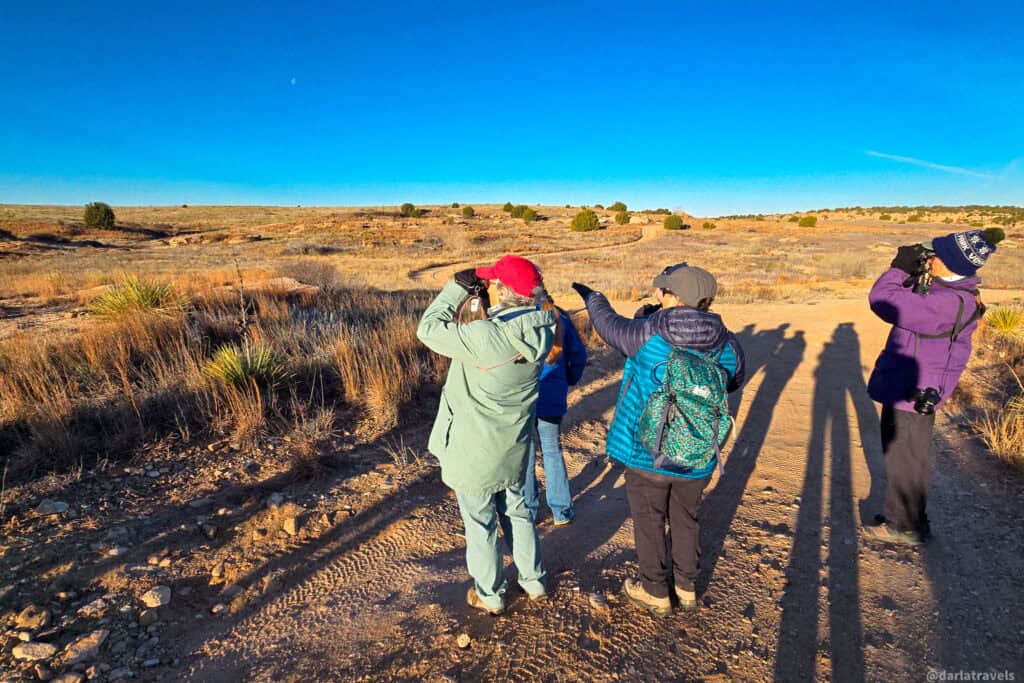
If you don’t own these things, I recommend at least buying or borrowing a pair of binoculars to ensure a satisfactory bird-watching experience.
Other Essential Items for your Birding Tours
Consider bringing the following items for your comfort on long outdoor tours in the arid, windy, and sunny environment of the high plains.
- Bring plenty of water with you wherever you go.
- Any snacks you may need.
- Hand warmers, either reusable or disposable air-activated chemical warmers (such as HotHands or Grabber).
- Sun protection (Yes, even in the winter): a brimmed hat, sunglasses, and sunscreen.
- Helpful Birding Apps or Books
- The Merlin app will help you identify birds by appearance, sound, or location.
- The eBird app lets you track sightings and explore recent observations in the area.
- A bird identification field guide book might also be helpful.
Where to Stay and Eat in Lamar During the Festival
All hotels in Lamar are within a 5-10 minute drive of Lamar High School, the central meeting place for tour departures and educational programs at the High Plains Snow Goose Festival. So the choice of lodging is entirely up to your personal preference.
Hotels and Lodging in Lamar, Colorado
Historic Cow Palace Inn: The Historic Cow Palace Inn has a bit more personality than your typical chain hotel, which makes it a nice fit for travelers who like a stay with character. With comfortable rooms, an on-site steakhouse and restaurant, and a convenient location, it’s an appealing home base for a weekend in Lamar.
Cobblestone Hotel & Suites – Lamar Cobblestone Inn & Suites is a chain with properties in smaller towns. I’ve recently been impressed with their other locations in eastern Colorado. Lamar’s Cobblestone offers a complimentary breakfast, a beer-and-wine bar, a fitness center, guest laundry, and an indoor pool. Rooms include microwaves, refrigerators, and luxury linens. It’s a dependable, comfortable option for travelers who prefer a newer hotel feel.
For comfortable budget rooms that include free Wi-Fi, a mini fridge, and a microwave, try the Days Inn by Wyndham Lamar. With an indoor pool and hot tub, it’s a good value for travelers looking for affordability.
Video walkthrough of my King Room at the Days Inn by Wyndham Lamar
Use the map and links below to research and book your lodging in Lamar, Colorado.
Book now at Booking.com ♦ Book now at Expedia ♦ Book now at Hotels.com
Local Restaurants and Dining Options
After a day of birding, wildlife tours, and exploring southeastern Colorado, you’ll be happy to know that Lamar offers a surprisingly diverse selection of local restaurants. Some places I recommend are:
AM Breakfast House (410 S. Main St.)
Located in a charming historic home, this is a great spot for a late breakfast after an early morning tour. The menu includes omelets, skillets, waffles, French toast, and breakfast burritos.
Becky’s Restaurant (105 Lee Ave.)
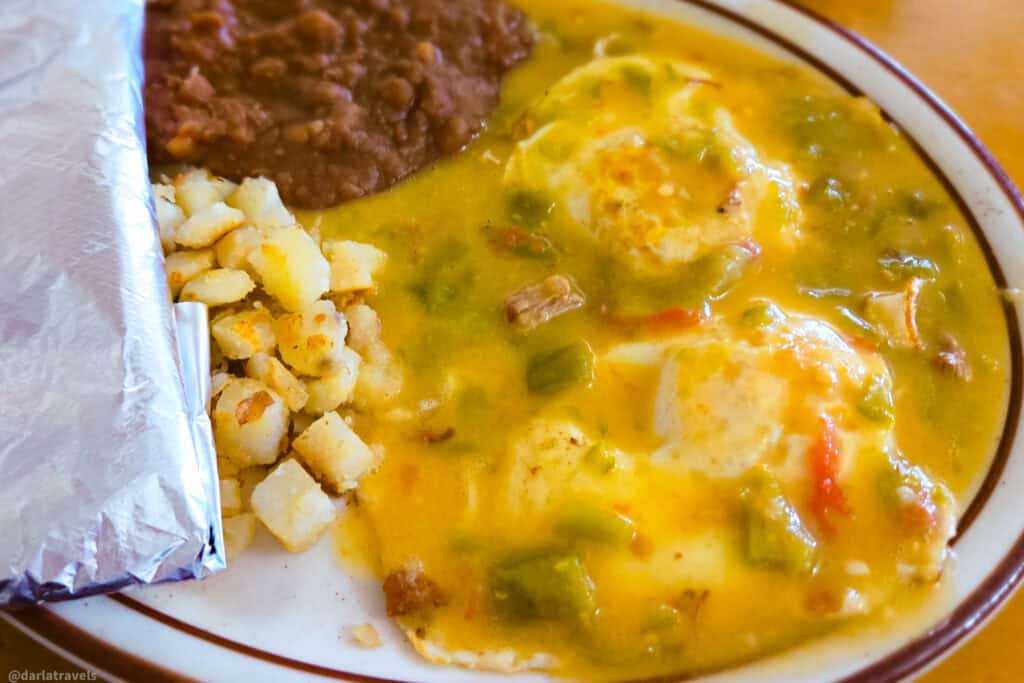
A casual local favorite serving both American and Mexican comfort food. Breakfast is served until 11 a.m. You’ll find tasty burgers, sandwiches, burritos, enchiladas, and nachos on the menu, among others.
Casa Azteca (1301 S. Main St.)
One of several Mexican restaurants in Lamar, Casa Azteca offers a large menu and a full bar. I highly recommend the carne asada tacos!
Tavern 1301 (1301 N. Main St.)
Located inside the Historic Cow Palace Inn, Tavern 1301 offers a more upscale dining experience. The menu features steaks, burgers, salads, pasta dishes, and creative specials made with Colorado-sourced ingredients.
BJ’s Burger and Beverage (1510 S. Main St.)
BJ’s is an old-school fast food burger joint known for its classic curb service. If you’re in the mood for a traditional American burger, this Lamar institution delivers. I ordered the triple cheeseburger and left happy.
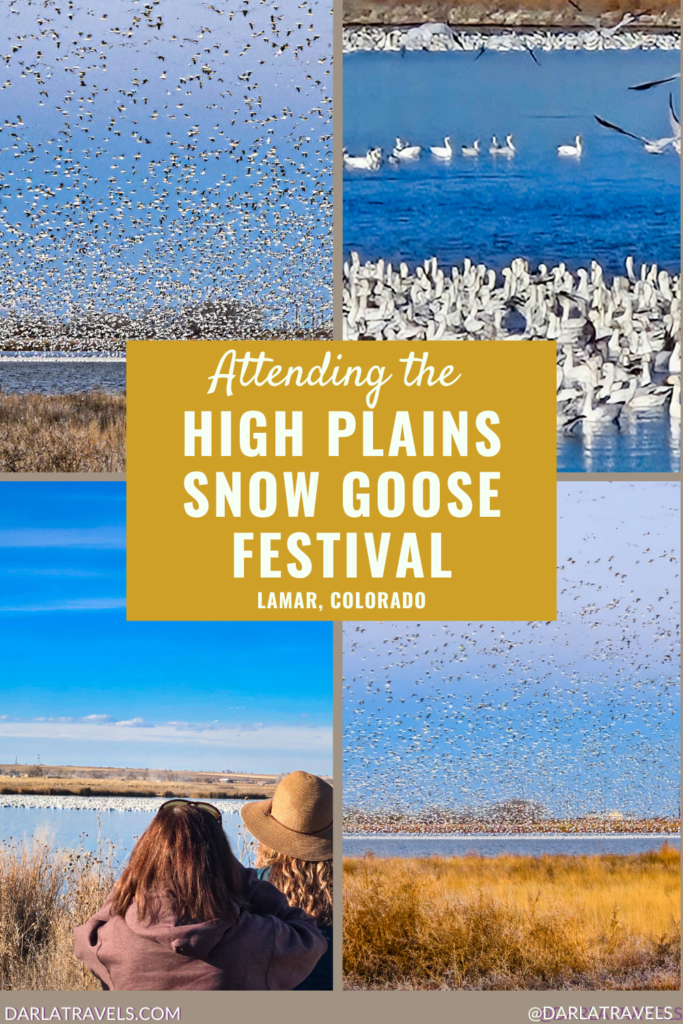
Pin It for Later- Lamar’s High Plains Snow Goose Festival
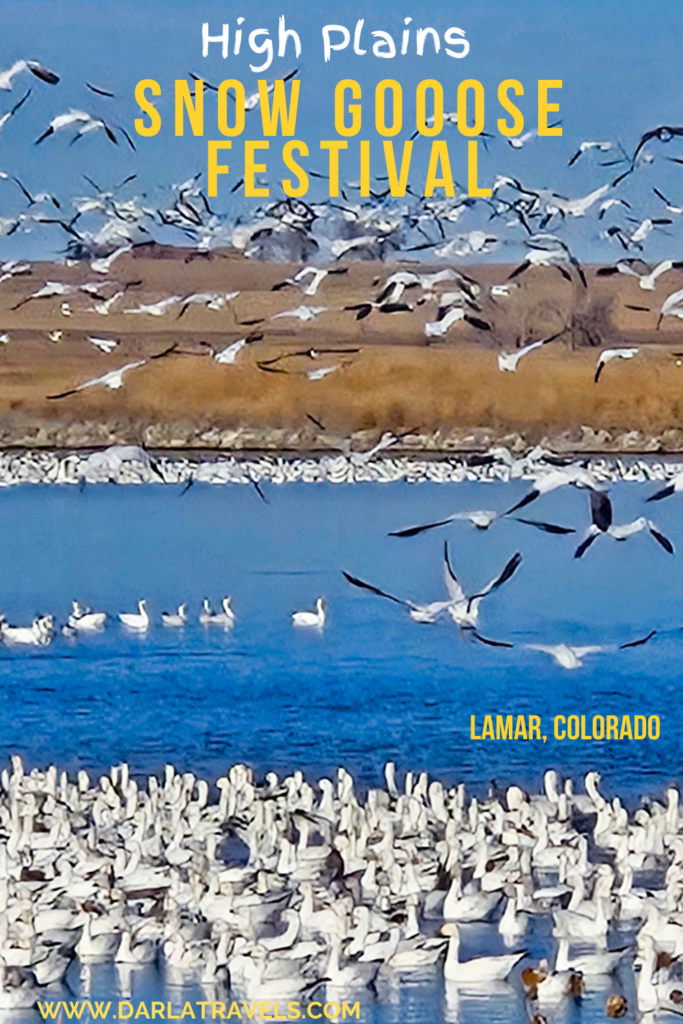
I created these images of snow geese and other festival shots for your Pinterest boards.
Final Thoughts: Why the Snow Goose Festival Is Worth a Winter Trip to Lamar
Lamar provides a front-row seat to one of North America’s great bird migrations, drawing birders, nature lovers, photographers, and experiential travelers to the annual High Plains Snow Goose Festival. More than a birding event, the festival highlights migrating snow geese, the prairie landscapes that sustain them, the wildlife that shares those habitats, and the local culture and history that give southeastern Colorado its character.
If this kind of experience appeals to you, a February trip to Lamar is well worth the journey. Don’t miss the chance to witness the snow geese in person for a few remarkable days before they continue their migration.
This looks like an amazing experience for wildlife lovers and photographers. We witnessed a similar spectacle during snow goose migration in New Mexico, and seeing thousands of birds fill the sky was absolutely unforgettable. Colorado has been on my list for the next migration season, and this festival sounds like the perfect excuse to visit. Thanks for sharing such a detailed guide!
Glad you liked the post! Thanks for the tip on New Mexico-maybe I’ll look into going there for a different view of the snow geese next time.
I’ve gone to the sandhill crane festival at the Monte Vista refuge, but hadn’t heard of the snow good festival. If we’re in Colorado this time next year, I’d like to go.
Glad you found the post useful!
This looks like a very interesting experience! Enjoyed watching the birding video and the walk-thorough of the room with your honest feedback. Now I can put a voice to your text! Those Huevos Rancheros for breakfast at Becky’s Restaurant looked absolutely amazing!!!
Thanks for your comment Michael-glad you enjoyed the post!
I love birding! I’ve written articles about birding before and I love taking pictures of birds in flight. This is amazing!
I love hearing that! You’d fit right in at this festival!